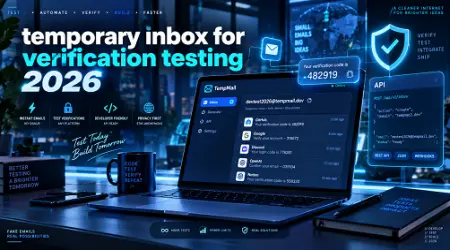
The Ultimate Guide to Using a Disposable Email Inbox in 2026: Stop Spam Cold
If you are anything like me, your primary email inbox is probably a digital battlefield. You have your important work emails and family updates fighting for space alongside newsletters you don’t remember signing up for, "last chance" discount offers, and notifications from that one app you downloaded five years ago and used exactly once.
It’s exhausting.
In 2026, digital privacy isn’t just about keeping hackers out; it’s about keeping your sanity intact. Every website, from recipe blogs to Wi-Fi portals at the airport, demands your email address just to let you in the front door. The moment you hand it over, you’ve opened the floodgates.
This is where a disposable email inbox becomes your best friend.
I’ve spent the better part of the last decade helping businesses and individuals clean up their digital footprints. In my experience, the single most effective habit you can build to protect your privacy and your peace of mind is stopping spam before it starts.
In this guide, I’m going to walk you through everything you need to know about disposable email addresses—how they work, why you need one right now, and how to use them to browse the web anonymously without tech headaches.
What Exactly is a Disposable Email Inbox?
Let’s strip away the jargon. Think of your real email address—the one you use for banking and talking to your mom—as your home address. You wouldn't give your home address to a stranger on the street just because they offered you a coupon, right?
A disposable email inbox (often called temp mail or a throwaway email) is like a PO Box that self-destructs. It is a temporary, fully functional email address that allows you to receive email for a short period, and then it vanishes.
There is no sign-up process. There are no passwords to remember. You don’t give them your name, your phone number, or your real email. You simply land on the website, grab a generated address, use it, and walk away.
The "Burner Phone" for the Internet
I like to compare these services to a burner phone. You use it for a specific purpose—maybe to verify an account or grab a download—and once that transaction is done, you toss it. If that email address ends up on a spam list (and it will), it doesn’t matter. The inbox doesn't exist anymore, and neither does the path back to you.
Why You Need a Temporary Email in 2026
You might be thinking, "I have a spam folder, isn't that enough?"
Here is the brutal truth: Spam filters are reactive. They try to catch the garbage after it has already been thrown at you. A disposable email address is proactive. It ensures the garbage never even gets aimed at your real house.
Here are the specific reasons why having a temporary inbox in your toolkit is non-negotiable today.
1. Protection Against Data Breaches
In 2026, data breaches are, unfortunately, a weekly news headline. When you sign up for a random forum or a small e-commerce site using your real email, you are trusting their security. If they get hacked, your email is now on the dark web, likely paired with a password you might use elsewhere.
By using a burner email, you sever that link. If a throwaway site gets hacked, the hackers steal an email address that expired ten minutes ago. Your identity remains safe.
2. Avoiding the Marketing "Drip"
Marketers are smarter than ever. They use sophisticated automation to send you "drip campaigns"—sequences of emails designed to wear you down until you buy.
I once signed up for a "free" industry report to see what would happen. Within two weeks, I received 14 emails from that company. If I had used my main inbox, that would have been 14 distractions. With a one-time email address, I got the report, closed the tab, and never heard from them again.
3. Testing Apps and Software
If you are a developer or just a curious user, you might want to test an app’s interface without committing to it. A fake email generator lets you create an account, look around, and leave without the baggage of a permanent profile.
See here…..TH13 base copy link 2026
How Does a Disposable Email Service Work?
Understanding the mechanics helps you use the tool better. You don’t need to be a coder to get this, but knowing a little bit about what happens behind the scenes helps explain why some services are better than others.
When you visit a temp email for verification site, the service assigns you an address from a pool of domains they own.
Here is the standard lifecycle:
- Generation: The script generates a unique string (e.g., [email protected]).
- Reception: The service keeps an SMTP (Simple Mail Transfer Protocol) server running. When you send an email to that address, their server catches it.
- Display: The website refreshes your browser to show the email content.
- Destruction: After a set time (10 minutes, an hour, or when you close the tab), the address and all its contents are wiped from the server.
The "Blacklist" War
This is something most people don’t realize: It is a constant game of cat and mouse. Websites like Netflix, Facebook, and Amazon know about disposable email services. They don't want you using them because they want your real data.
So, they maintain "blacklists" of domains used by these providers. If you try to sign up with [email protected], the site might say, "Please enter a valid email address."
This is why the best disposable email inbox providers constantly buy new domain names. If one domain gets blocked, they rotate to a new one. It’s a behind-the-scenes battle that keeps your anonymity alive.
Real-World Scenarios: When to Use (and When Not to Use) Temp Mail
Not all emails are created equal. In my experience, knowing when to use a temporary inbox is just as important as knowing how.
The "Green Light" Scenarios (Go for it!)
- Public Wi-Fi Portals: You are at the airport or a coffee shop. They want your email to give you 30 minutes of free internet. This is the perfect use case. They only want to market to you later. Give them a temp mail.
- Gated Content: You want to read a news article or download a whitepaper, but it’s locked behind an email wall.
- Shopping Discounts: A store offers "10% off your first order if you subscribe." Use a disposable email address to get the coupon code, use the code, and avoid the newsletters.
- Untrusted Forums: You need to ask a question on a random message board but don’t want to be associated with it forever.
The "Red Light" Scenarios (Please, use your real email)
- Banking and Finance: Never, ever use a burner email for PayPal, crypto exchanges, or bank accounts. If you need to reset your password later, you will be locked out because the email address no longer exists.
- Medical Records: Anything involving sensitive health data needs a secure, permanent channel.
- Job Applications: It looks unprofessional, and you will miss the interview invitation if the inbox expires.
- Purchases with Warranties: If you buy a laptop and the receipt goes to a throwaway email, good luck claiming the warranty in six months.
Step-by-Step: How to Use a Disposable Email Inbox
If you are a beginner, don’t worry. This is incredibly easy. You don’t need to install software or learn to code.
Step 1: Choose Your Provider There are dozens of free sites. You can search for "temp mail" or "10 minute mail." Look for one that loads quickly and has a clean interface.
Step 2: Generate the Address Usually, you don’t even have to click a button. The moment you land on the homepage, a random email address will be waiting for you in a text box.
Step 3: Copy to Clipboard Click the "Copy" button next to the weird-looking email address.
Step 4: Paste into the Target Website Go to the site asking for your info. Paste the address into the registration field.
Step 5: Wait for Verification Go back to the disposable email tab. Keep it open! Most services auto-refresh, but some require you to click a "Refresh" button. Within seconds, the verification email ("Please confirm your account") should appear.
Step 6: Click and Verify Open the email, click the confirmation link, and you are done. You can now close the tab and forget that email address ever existed.
See here….How to lose weight without dieting
Advanced Tactics: Aliases vs. Disposable Inboxes
As we move through 2026, the line between a "burner" email and an "alias" is getting blurry. It is worth knowing the difference so you can choose the right tool.
The Pure Disposable (No-Signup Email)
This is what we have discussed so far. No account needed. Totally anonymous. It lasts minutes or hours.
- Best for: One-time verifications, sketchy sites.
The Email Alias (Masked Email)
Services like Apple’s "Hide My Email" or Firefox Relay offer email aliases. These are "fake" addresses that forward mail to your real inbox.
- How it works: You give Amazon an alias like [email protected]. Amazon emails that address, and Apple forwards it to your real Gmail.
- The Benefit: You can turn off the forwarding if the spam gets too bad, but you keep a record of the emails long-term.
- Best for: legitimate shopping sites, newsletters you might want to read for a while, or subscription services (Netflix, Spotify).
In my opinion, you need both. Use aliases for accounts you want to keep but don't fully trust. Use disposable inboxes for one-offs you never want to hear from again.
Common Mistakes Beginners Make
After watching people use these tools for years, I see the same errors pop up repeatedly. Avoid these to keep your digital life smooth.
1. Closing the Tab Too Soon Some verification emails take 2-3 minutes to arrive, especially if the sender's server is slow. I’ve seen people generate an email, paste it, and immediately close the temp mail tab. Then they realize they need to click a link to verify, but the inbox is gone forever. Rule of thumb: Keep the tab open until you are fully logged into the service you are signing up for.
2. Trying to Recover an Old Address People often ask me, "I used a temp mail last week for a Facebook account, and now Facebook wants to verify me again. How do I get that email back?" The short answer: You don’t. Once a temporary inbox expires, it is usually deleted permanently. This is why I stressed earlier: do not use this for accounts you intend to keep long-term.
3. Ignoring Privacy Policies Just because you are anonymous to the sender doesn't mean you are anonymous to the temp mail provider. The provider can technically read the emails coming into that inbox.
- Pro Tip: Never have a password reset link for a sensitive account sent to a public free disposable email. Anyone who happens to stumble upon that same temporary address (rare, but possible on low-quality sites) could click it.
Analyzing the "Spam Protection" Aspect
Let’s dig a little deeper into spam protection.
When you provide your email to a website, you are often agreeing to their Terms of Service. Buried in those terms is usually a clause that allows them to share your data with "partners."
"Partners" is corporate-speak for data brokers.
These brokers aggregate lists of millions of active email addresses and sell them. This is why you suddenly get emails about refinancing a mortgage you don't have or buying supplements you don't need.
By using a privacy email or burner email, you are poisoning the well for data brokers. You are giving them dead data. If everyone did this for low-value transactions, the market for spam lists would crash. Using these tools isn't just convenient; it’s a small act of rebellion against the surveillance economy.
Pros and Cons of Disposable Email Inboxes
To give you a balanced view, here is a quick breakdown of the good and the bad.
The Pros
- Total Anonymity: No personal data required.
- Zero Spam: Your real inbox remains pristine.
- Speed: Faster than creating a new Gmail or Outlook account.
- Free: Most high-quality services cost nothing.
- Security: Protects your primary email from phishing attacks.
The Cons
- Short Lifespan: Once it's gone, it's gone.
- No Outbound Mail: Most services only allow you to receive, not send.
- Blacklisting: Some websites automatically block known temp domains.
- No Privacy from Provider: The service host can see the incoming mail.
Frequently Asked Questions (FAQs)
Q: Is using a disposable email inbox illegal? A: Absolutely not. It is perfectly legal to use a temporary email address. You are simply managing your own privacy. However, using them to commit fraud or harassment is, of course, illegal.
Q: Can I send emails from a temp mail address? A: Generally, no. Most free disposable email services are "receive-only." This is to prevent spammers from using the service to send junk mail to others.
Q: How long does the email address last? A: It varies by provider. Some last 10 minutes, some last 24 hours, and others last until you delete them manually. Always check the timer on the site.
Q: Why do some websites reject my disposable email? A: The website has likely flagged the domain name (e.g., @tempmail.com) as a temporary service. If this happens, try a different provider or look for a service that allows you to choose from different domains.
Q: Can I create a custom name for my temp mail? A: Some premium or advanced services allow this (e.g., [email protected]), but most free versions assign you a random string of characters like x7z99q@....
Q: Are these services safe from viruses? A: The email service itself is a website, so it's relatively safe. However, the emails you receive can still contain malicious links or attachments. Just because you are using a burner email doesn't mean you should click on suspicious links inside the messages.
Conclusion: Take Back Control of Your Inbox
In 2026, your attention is your most valuable currency. Every time your phone buzzes with a spam email, you are paying a "tax" on your attention.
The disposable email inbox is the most effective tool available to stop paying that tax. It empowers you to explore the internet, sign up for trials, and access information without mortgaging your future peace of mind.
It takes five seconds to generate a temp mail. It takes hours to unsubscribe from spam lists. The math is simple.
Here is my challenge to you: The next time a website asks for your email address and you feel that hesitation—that gut feeling that says, "I'm going to regret this"—stop. Open a new tab. Search for a disposable email address. Use it.
Once you realize how clean and quiet your real inbox can be, you will never go back.
Stay safe, keep your data private, and happy browsing.