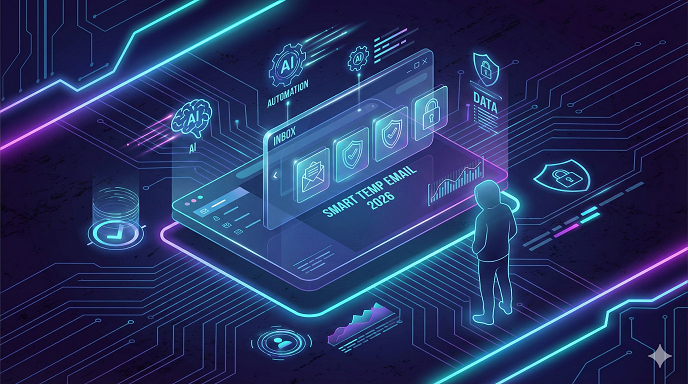
Smart Temporary Email 2026: The Ultimate Guide to Protecting Your Inbox
Look, we have all been there. You just want to read one article, grab a quick 15% discount code, or check out a new app. But there is a catch: they want your email address.
You hesitate. You know exactly what happens next. First, it’s the welcome email. Then, a newsletter. Then, three days later, a "Just checking in!" nudge. Before you know it, your primary inbox—the one you use for work, family, and important bills—is a war zone of spam, marketing fluff, and potential phishing attempts.
In the past, we just dealt with it. Or maybe we created a "junk" Gmail account that we checked once a year. But in 2026, the game has changed. We aren't just using "fake" emails anymore; we are using smart temporary email solutions.
If you are still handing out your real email address to every random website in 2026, you are doing it wrong. I’ve spent the last decade working in digital strategy and cybersecurity, and I can tell you: protecting your digital identity has never been harder, but the tools to do it have never been smarter.
Here is everything you need to know about navigating the world of disposable addresses, anonymous inboxes, and the rise of smart temp mail in 2026.
What Exactly is a "Smart" Temporary Email?
You might be familiar with the old school "10-minute mail" concept. You click a button, get a gibberish address like [email protected], and it vanishes before you can even refresh the page.
That was the old way. It was clunky, often blocked by major websites, and honestly, a bit of a hassle.
A smart temporary email in 2026 is different. It isn’t just a trash bin; it’s a privacy shield. These tools have evolved to mimic real user behavior. They offer domains that look legitimate, inboxes that persist until you decide to kill them, and sometimes even smart forwarding features that let you receive verification codes to your real phone or email without exposing your actual contact info.
The Core Difference: Dumb vs. Smart
- Old "Dumb" Temp Mail: Generated instantly, blocked by Netflix/Facebook/Google, expires in 10 minutes, zero recovery options.
- Smart Temp Mail 2026: Uses premium domains (looks like a business or personal email), bypasses strict spam filters, allows for replies (sometimes), and offers "inbox binding" so you can keep the address for a few days if you are waiting on a delayed confirmation.
In my experience, the shift to "smart" tools was necessary because websites got smarter at blocking the generic temporary email generator sites. To beat the blockers, the privacy tools had to evolve.
See here….TH13 Best Home CoC Base
Why You Need a Smart Temp Mail in 2026
I recently ran a test where I signed up for 50 different "free" newsletters using a fresh, unprotected email address. Within 48 hours, I had received 127 emails. Only about 30 of them were legitimate newsletters. The rest? Sold data, third-party offers, and straight-up spam.
Here is why a disposable email address is your best friend this year:
1. The "Data Broker" Defense
Most people don’t realize that when you sign up for a free contest or a low-tier service, your email is often the product. It gets packaged into a list and sold to data brokers. By using a smart temp mail, you sever the link between your identity and that data. When they sell the email, they are selling a dead end.
2. Avoiding the "Unsubscribe" Dance
We have all tried to unsubscribe from a mailing list, only to find it takes "10 business days" or, worse, the unsubscribe link is broken. With a temporary email inbox, you don’t need to unsubscribe. You just stop looking at it. Or, if it's a truly disposable alias, you delete the alias. Problem solved.
3. Security and Verification
I often use a fake email for verification when testing new software or accessing gated content (like whitepapers). In 2026, malware delivered via email is sophisticated. If you open a malicious attachment in a temporary web-based inbox, your actual computer and primary email client remain much safer than if you downloaded it to your Outlook or Apple Mail.
How Smart Temporary Email Works Under the Hood
You don't need to be a tech wizard to use these, but understanding the mechanics helps you choose the right privacy email tool.
When you visit a temp mail 2026 service, the backend system assigns you an alias. This alias points to a server that collects incoming mail.
- The Front End: You see a clean inbox interface in your browser.
- The Back End: The service accepts the email, strips out tracking pixels (a common feature in smart services), and displays the text/HTML to you.
The "Smart" Rotation
Here is the secret sauce: Good services rotate their domains constantly. If a service uses @tempmail.com, huge websites like Amazon or Instagram will blacklist that domain immediately. Smart services buy hundreds of generic-sounding domains (e.g., @consulting-solutions.io or @newsletter-hub.net) and rotate them daily. This ensures high deliverability rates for your verification codes.
Step-by-Step: Using a Smart Temp Mail Effectively
Let’s walk through a real-world scenario. Say you want to try out a new AI video editor that requires a sign-up, but you don’t trust them with your data.
Step 1: Choose Your Provider
Do not just Google "temp mail" and click the first ad. Look for a clean interface. If the site is riddled with pop-up ads, the email service is likely slow or insecure. Look for a smart temporary email service that loads quickly.
Step 2: Generate the Address
Click the generate button.
- Pro Tip: If the service gives you a weird address like [email protected], try refreshing. Look for a domain that sounds realistic, like [email protected]. This increases the chances of the sign-up form accepting it.
Step 3: The Copy-Paste
Copy the address to your clipboard. Go to the service you are signing up for. Paste it in.
- Warning: Keep the temp mail tab open! Do not close it yet. Many people make the mistake of closing the tab immediately, thinking they are done. You need to wait for the verification link.
Step 4: Verification and Interaction
Switch back to your temporary email inbox. You should see the incoming mail within seconds. If it takes longer than a minute, hit refresh. Click the verification link.
Step 5: The "Burn"
Once you are in the app, you are done. You can close the tab. The email address will self-destruct after a set period (usually 1 hour to 24 hours), taking all that potential spam with it.
Top Features to Look for in 2026
Not all disposable tools are created equal. If you are shopping around for a reliable anonymous email service, look for these specific "smart" features:
1. Custom Aliases
Basic tools give you [email protected]. Smart tools let you choose [email protected]. This is surprisingly helpful because some spam filters block addresses that look like random strings of characters.
2. Timer Extension
Have you ever waited 15 minutes for a verification code, only for your temp email to expire at the 10-minute mark? It is infuriating. Smart services have a "Give me 10 more minutes" button or allow the inbox to stay active as long as the tab is open.
3. Attachment Handling
Basic tools strip attachments. Smart tools allow you to view (or safely preview) attachments. This is crucial if the "gated content" you signed up for is a PDF sent via email.
4. Mobile Responsiveness
In 2026, we do everything on phones. If the temp mail site looks like a desktop site from 2010, skip it. You need a responsive design to grab that code while you're on the go.
Real-World Use Cases: When to Use Smart Temp Mail
I want to be clear: you shouldn't use a disposable address for everything. Here is my personal rule of thumb for when to use a smart temp mail versus your real Gmail or Outlook.
The "Green Light" Scenarios (Use Temp Mail)
- One-Time Downloads: Ebooks, whitepapers, cheat sheets.
- Public Wi-Fi Logins: Airports and coffee shops that force you to enter an email to connect. (This is a huge one!)
- Shopping for Quotes: If you are looking for car insurance or a contractor quote, never use your real email unless you want your phone to ring off the hook for six months.
- Beta Testing: Trying out new apps that might be buggy or spammy.
The "Red Light" Scenarios (Use Real Mail)
- Banking and Finance: Never, ever use a disposable email for PayPal, crypto exchanges, or bank accounts. If you lose access to the email, you lose your money.
- Medical Records: Too risky.
- Primary Social Media: If you care about your main Instagram or LinkedIn, use a real email. If you get locked out, you need a permanent address for recovery.
- Job Applications: It looks unprofessional and you might miss the interview invite.
Comparison: Smart Temp Mail vs. Traditional Filters
A common question I get is: "Why not just use Gmail filters or aliases (like [email protected])?"
That is a valid strategy, but it isn't foolproof.
In my experience, Gmail aliases are great for organizing incoming mail (like knowing which newsletters you signed up for), but they are terrible for privacy. A savvy marketer knows exactly how to strip the alias and target your main inbox.
Common Mistakes Beginners Make
Even with a tool as simple as a temporary email generator, things can go wrong. I have seen smart people make silly mistakes that cost them access to accounts.
Mistake 1: Using it for "Password Forgot" Recovery
I once had a client who set up a secondary Twitter account using a temp mail. Six months later, they forgot the password. They clicked "Reset Password," and Twitter sent the link to... an email address that hadn't existed for 179 days. The account was lost forever.
Rule: If you need the account for more than 24 hours, do not use a disposable email.
Mistake 2: Trusting Private Data to Free Services
Remember, most free temp mail 2026 sites are public or semi-public. Some very basic ones allow anyone who knows the alias to check the inbox.
- Example: If you choose [email protected], someone else might check [email protected] and see your emails.
Fix: Always use smart temporary email services that generate unique, randomized tokens or password-protected sessions for that inbox.
Mistake 3: Closing the Browser Too Soon
I mentioned this earlier, but it bears repeating. Some emails take 5–10 minutes to arrive due to "greylisting" (a spam filter technique). If you close the tab after 30 seconds, you might miss the mail.
See here…Top AI tools for content creators
The Future of Email Privacy
As we move deeper into 2026, privacy is becoming a luxury. Browsers are killing cookies, and tracking is becoming harder, so marketers are relying more heavily on email addresses as the "unique identifier" for users.
This means your email address is becoming your digital social security number. Protecting it is no longer just about avoiding annoyance; it’s about cybersecurity hygiene.
I predict that in the next few years, we will see "Smart Temp Mail" features integrated directly into operating systems and browsers (Apple is already doing this with "Hide My Email," and others will follow). But until that is universal and cross-platform, third-party smart temp mail tools are the most effective shield you have.
FAQs: Smart Temporary Email
Q: Is using a temporary email address illegal?
A: No, absolutely not. You have the right to privacy. However, using them to commit fraud, spam others, or abuse services is illegal. Using them to protect your own inbox is perfectly fine.
Q: Can I recover a smart temporary email once it is closed?
A: generally, no. That is the point. Once the session ends, the data is wiped. Some premium services offer a "recover" feature for a short window, but don't count on it.
Q: Why do some websites block disposable email addresses?
A: They want your real data for marketing purposes, or they want to prevent users from abusing free trials (creating 100 accounts to get 100 free months).
Q: Are these services free?
A: Most temporary email generator tools are free and supported by ads. There are paid versions that offer custom domains and no ads, which are great for power users.
Q: How long does a smart temp mail last?
A: It varies. Some last 10 minutes, some 24 hours. Some "smart" services allow the email to exist as long as you keep the browser tab open.
Q: Can I send emails from a temporary address?
A: Most services allow you to receive only. Sending is usually disabled to prevent spammers from using the platform to blast out junk mail.
Conclusion: Take Back Your Inbox
The internet of 2026 is noisy. Everyone wants a piece of your attention, and they demand your email address as the price of admission. But you don't have to pay it.
By utilizing a smart temporary email, you are taking control. You are deciding who gets access to your personal digital space and who gets the door. It is a small habit—opening a new tab, generating a fake email for verification, and copying it over—but it saves you hours of deleting spam and potential security headaches down the road.
Here is my challenge to you: The next time a website asks for your email for something trivial—a coupon, a quiz result, or a "read more" gate—don’t autopill your real address. Stop. Use a smart temp mail. Your future self (and your clean inbox) will thank you.