Instant Temp Mail 2026: The Ultimate Guide to Reclaiming Your Inbox Privacy
It’s 2026, and if your primary email inbox looks anything like mine, it’s probably a complete disaster zone. I get it. Every time you try to read a simple article, download a basic checklist, or test out a new software tool, you are hit with a mandatory popup demanding your email address. It is exhausting. You hand over your real address, and suddenly, you are enrolled in a seven-day automated drip campaign that you never asked for, followed by endless promotional blasts.
In my experience as a digital strategist who tests dozens of web tools and software-as-a-service (SaaS) platforms every single week, guarding your real email address has never been more critical. The aggressive data-harvesting tactics of modern websites have made it nearly impossible to browse the web freely without sacrificing your privacy.
That is exactly where finding a reliable instant temp mail 2026 solution comes in. It is no longer just a clever trick for tech geeks; it is a fundamental survival tool for the modern internet. Today, I am going to walk you through exactly how to use a temporary email to keep your personal and professional inboxes clean, secure, and entirely spam-free.
We will look at the mechanics, the best use cases, the hidden dangers, and how the technology has evolved so you can navigate the web completely under the radar.
What Exactly is a Temporary Email?
At its most basic level, a temporary email (often called a throwaway email or burner inbox) is a short-lived, self-destructing email address. It is an inbox created on the fly that requires absolutely zero personal information from you.
You don't need to create a password. You don't need to provide a phone number. You don't even need to type in your name.
When you visit a free temp mail website, the system automatically generates a random email address for you. You use that address to sign up for whatever service is demanding it, receive the confirmation link or code, and then you simply close the browser tab.
Once you leave, that instant temporary email vanishes forever. Any future spam, newsletters, or data-broker sales tied to that address simply bounce into a digital black hole. It is the ultimate no signup email solution for anyone who values their digital sanity.
The Core Difference Between Real and Fake Email Generators
Most people don't realize how much of a footprint they leave when using a primary Gmail or Outlook account. Your real email is tied to your identity, your browsing habits, and often your credit cards. A fake email generator severs that link entirely. It provides a temporary inbox that acts as a shield, absorbing the spam so your real inbox doesn't have to.
Why the Desperate Need for Instant Temp Mail in 2026?
You might be wondering why we are talking about this so urgently right now. Hasn't spam always been a problem? Yes, but the digital landscape has shifted drastically over the last few years.
Here is what most people don’t realize is happening behind the scenes when you hand over your email today:
- The Rise of Aggressive Gated Content: Almost nothing is truly free anymore. Whether it is a whitepaper, a webinar, or a simple recipe, marketers lock content behind email capture forms.
- Cross-Platform Data Selling: Your email address is the ultimate unique identifier. When you give it to "Company A," they often share it with data brokers who match it against your social media profiles, creating a hyper-targeted profile to sell to "Company B."
- Mandatory Account Creation: Want to buy a single t-shirt from a new brand? You have to create an account. Want to check the shipping rates? Enter your email. The friction is relentless.
This is why an instant temp mail 2026 strategy is your best defense. It allows you to bypass these digital tollbooths without paying the price of a compromised inbox.
How a Disposable Email Address Works (Step-by-Step)
If you have never used an anonymous email before, the process is shockingly simple. You don't need to be a developer or a cybersecurity expert to figure it out.
Here is exactly how I use them in my day-to-day workflow:
- Hit the Barrier: You land on a website that requires an email address to proceed, but you know you will never use this site again.
- Open a New Tab: Navigate to your preferred privacy email tool.
- Copy the Address: The homepage will display a randomly generated email address instantly (e.g., [email protected]). Click the "copy" button.
- Paste and Submit: Go back to the original website, paste the disposable email address into their form, and hit submit.
- Wait for the Email: Keep the temp mail tab open. Within seconds, the website's automated system will send a confirmation link or OTP (One Time Password). It will appear right there on the web page.
- Verify and Discard: Open the email, click the verification link or copy the code. You now have access to the site. Finally, close the temp mail tab. You are done.
It is a completely frictionless, spam-free inbox experience.
See here………..Top digital marketing strategies that work 2026
Real-World Scenarios: When to Use a Temp Mail for OTP and Verification
Knowing how to use a throwaway email is easy; knowing when to use it is where you start taking real control of your digital life. Here are the most common scenarios where I rely on these tools.
1. Testing New Software and SaaS Platforms
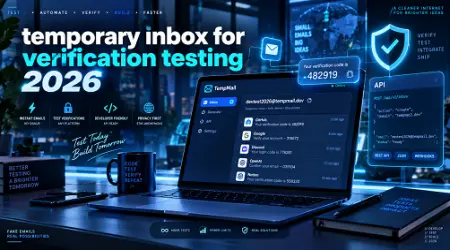
In my line of work, we are constantly evaluating new marketing tools, developer APIs, and productivity software to see if they fit our tech stack. If I used my real corporate email for every free trial, my inbox would be unusable within a week. I always use a temporary email for verification when testing a new dashboard. Once I know the tool is actually good, then I will upgrade to a paid plan using my real address.
2. Snagging One-Time E-commerce Discounts
We have all seen it: "Enter your email for 20% off your first order!" If you just want the discount code and have zero interest in receiving three emails a week about their upcoming summer sale, a 10 minute mail service is the perfect workaround.
3. Public Wi-Fi Logins
When you are traveling or sitting in a coffee shop, the free Wi-Fi often asks for an email address before letting you connect. These networks are notorious for selling user data to local advertisers. Never give them your real email. Use a fake email generator instead.
4. Reading Gated News Articles
Many news sites allow you to read "3 free articles a month" if you create an account. A one-time email lets you bypass these soft paywalls in seconds so you can read the information you need and move on.
Pros and Cons of Using a Disposable Email Address
While I am a huge advocate for using a temporary inbox, it is important to understand the limitations. They are incredibly useful, but they aren't a silver bullet for everything.
Common Mistakes When Using 10 Minute Mail Services
After working with these tools for years, I have seen people make some critical errors. A privacy email tool is powerful, but misuse can lead to massive headaches.
Mistake 1: Using it for long-term accounts.
I cannot stress this enough. If you use an instant temporary email to sign up for a service that you plan to use for months, you are setting yourself up for failure. The second you log out and forget your password, you are permanently locked out of that account. There is no password recovery because the email address no longer exists.
Mistake 2: Trusting it with sensitive data.
Temporary inboxes are public by nature. While the chance is slim, if someone else randomly generates the exact same alias you used, they could see the emails sitting in that temporary inbox. Never use a temp mail for OTP if the account handles financial data, personal health information, or crypto wallets.
Mistake 3: Getting frustrated by domain blocks.
Many high-tier websites (like Google, Facebook, or major banks) maintain lists of known disposable domains and will block you from registering. If a site rejects your throwaway email, don't panic. Simply refresh the temp mail page to generate an address with a different domain, or accept that the site requires a real email.
The Evolution: From Basic "10 Minute Mail" to Advanced Anonymous Email
The technology behind throwaway emails has matured significantly by 2026. A decade ago, the standard was literally a "10 minute mail" site that gave you a random string of numbers and a ticking clock. When the clock hit zero, the inbox exploded.
Today, the landscape is much more sophisticated.
API Integrations and Developer Tools
We are now seeing developer-specific disposable email APIs. This means quality assurance teams can automate the creation of thousands of temporary inboxes to test their own website's email outreach sequences and user registration flows. This ensures that when a company launches a product, their email servers actually work, without needing to manually create hundreds of Gmail accounts.
Custom Aliases and Forwarding
While traditional instant temp mail is still incredibly popular, the market has expanded to include email alias services. These tools generate unique, random addresses that actually forward to your real inbox. If an alias starts getting spammed, you just click a toggle to disable it. It bridges the gap between a pure burner inbox and long-term account management.
Faster Routing and Better Domains
In the past, waiting for an automated system to send a verification code to a fake email generator could take five minutes. Today, the routing is near-instantaneous. Furthermore, the best services constantly rotate their domain names (e.g., switching from @mailinator.com to an obscure, fresh domain) to stay one step ahead of website blacklists.
See here………..Th13 most powerful war base Proven Layouts + Deep Defense Guide (2025)
Frequently Asked Questions (FAQs)
1. Is using a temporary email address legal?
Absolutely. There are no laws against protecting your primary inbox from spam. Using an anonymous email to protect your privacy is completely legal. However, using it to commit fraud, harass others, or bypass bans on platforms violates their terms of service.
2. Can I reply to an email using a free temp mail service?
Usually, no. The vast majority of disposable email providers are "receive-only." This is by design to prevent spammers from using their servers to send out malicious campaigns. They are meant strictly as a temporary inbox to catch incoming mail.
3. How long does an instant temporary email actually last?
It varies by provider. Some strict "10 minute mail" services delete everything after 600 seconds. Others will keep the session active as long as you keep your browser tab open. Once you close the tab or manually hit the "delete" button, the inbox is wiped permanently.
4. Can websites detect that I am using a fake email generator?
Yes, sometimes. Advanced platforms use databases that track the domain names (the part after the @ symbol) of known disposable email providers. If they detect a match, they will block the registration. The best temp mail services get around this by constantly adding new, unlisted domains to their rotation.
5. Are free temp mail services secure?
They are secure in the sense that they protect your primary identity. But the temporary inbox itself is entirely unencrypted and theoretically public. Do not use them to receive sensitive, personal, or financial information.
6. What is the best temp mail for OTP (One Time Passwords)?
The best tools are simply the ones with the fastest server response times and the cleanest domain reputations. You want a service where the page auto-refreshes seamlessly so you can grab the 6-digit code and verify your account without waiting.
Conclusion: Your Spam-Free Inbox Awaits
Navigating the web in 2026 shouldn't require you to sacrifice your personal data to every website that asks for it. Your email address is a direct line to your daily life—it is where you do business, communicate with family, and manage your finances. It deserves to be protected.
By integrating an instant temp mail 2026 strategy into your daily browsing habits, you instantly cut off the endless stream of promotional junk, tracking pixels, and unsolicited outreach. Whether you are a digital professional testing out a new piece of software, or just someone trying to get a 10% discount on a pair of shoes, a disposable email address is the smartest, fastest way to take back control of your privacy.
Stop handing over your digital keys to strangers. Start using a temporary inbox, and keep your real email strictly for the things that actually matter.