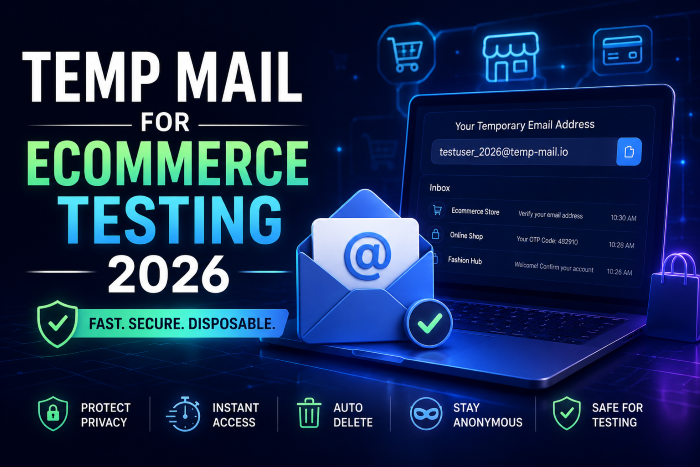
The Insider's Guide to Temp Mail for E-commerce Testing 2026: Speed Up QA and Catch Bugs Fast
I still remember a disastrous launch a few years back. A massive new e-commerce brand was going live. The site looked beautiful, the payment gateways were flawlessly integrated, and the inventory was locked and loaded. But there was one massive oversight. No one had thoroughly tested the email flows with fresh, isolated accounts.
When the floodgates opened, thousands of new users tried to sign up. The system's automated welcome emails and OTP (One-Time Password) verifications got flagged by major email providers as spam due to sudden, unverified volume. Customers couldn't log in. Carts were abandoned. It was an absolute nightmare that cost the client thousands in the first hour alone.
If they had used a proper temp mail for ecommerce testing 2026 strategy, the entire catastrophe could have been avoided.
In my experience, what most people don’t realize is that testing your store's email infrastructure isn't just about making sure the message sends. It’s about ensuring it lands in the primary inbox, renders beautifully on mobile, and triggers the exact right sequence in your backend. Today, setting up a disposable email for QA testing is non-negotiable for developers, QA teams, and store owners.
Let's break down exactly how to test your ecommerce email flows, the tools you need, and the common pitfalls that trap even seasoned developers.
Why Temp Mail for Ecommerce Testing 2026 is a Game Changer
Testing an online store involves creating dozens, sometimes hundreds, of user accounts. If you try to use your personal Gmail, you'll quickly run into the classic "+1" trick limitations (like [email protected]). While that worked perfectly five years ago, modern ecommerce platforms and anti-fraud algorithms are incredibly aggressive. They often flag these variations as bot activity, temporarily blocking your IP or locking your test accounts.
This is where a fake email for e-commerce testing comes in. But let's clarify the terminology—"fake" doesn't mean malicious. It means a temporary, secure, and isolated inbox designed specifically to catch automated system emails during your development and staging phases.
The Evolution of E-commerce QA Testing
In 2026, privacy regulations and spam filters are tighter than ever. If your store sends a poorly formatted transactional email, it doesn't just bounce; it hurts your domain reputation.
Using an email testing tool allows you to intercept outgoing messages before they ever hit the real internet. It gives you a pristine environment to inspect headers, check HTML formatting, and verify that your DKIM and SPF records are actually doing their jobs. Whether you are running a monolithic Magento build or a headless Shopify setup, integrating a temporary inbox 2026 solution into your workflow is the only way to ensure your customers actually hear from you.
How a Disposable Email for QA Testing Actually Works
At its core, a disposable mailbox for developers functions as a temporary catch-all. When you generate a new address, it exists on a server completely separate from major providers like Google or Microsoft.
When your ecommerce site fires off an email—say, a password reset link—the temporary server receives the payload. You can then view the email in a web interface or pull it via an API to verify the contents. Once you close the session or a set timer expires, the inbox and its contents are wiped clean.
This completely bypasses the inbox clutter. You never have to spend Friday afternoon deleting 400 "Test Order #992" emails from your work account. It keeps your primary workspace clean and your testing environment highly organized.
Top Strategies: Using a Temp Email Generator 2026
You shouldn't just be testing your newsletter signup. A robust QA strategy requires validating every single touchpoint a user has with your store. Here is how you should be applying these tools.
1. Validating the User Registration Flow
When a user creates an account, they usually expect an immediate welcome email with a discount code. Using a test email inbox, you can script an automated test that fills out the signup form, waits for the email, and verifies that the dynamic tags (like "Hi [First Name]") are populated correctly. If the variable comes through blank, you know your database mapping is off.
2. Order Confirmation and Receipt Delivery
The moment a customer hands over their credit card, their anxiety spikes. If they don't get a receipt within seconds, they hit up customer support. E-commerce website testing must include placing dummy orders and verifying that the receipt includes the correct line items, tax calculations, and shipping addresses.
3. Temporary Email for OTP Testing (The Critical Step)
This is a big one. Two-factor authentication and OTP logins are standard practice now. But OTPs are time-sensitive. If your mail server lags, the OTP expires before the user can type it in. Using a temporary email for OTP testing allows developers to measure the exact latency between the trigger and the inbox delivery. If it takes longer than 15 seconds, your infrastructure needs optimization.
4. B2B and Wholesale Approval Loops
For B2B ecommerce, user registration often requires manual admin approval. You can use an anonymous email testing setup to simulate the customer waiting for approval, while using a secondary test account to act as the store admin triggering the "Account Approved" notification.
See here……………Understanding the Importance of a TH9 Farming Base
Real-World Case Study: The Abandoned Cart Nightmare
After working with a high-volume apparel brand last year, I witnessed firsthand why test account creation needs to be systematic.
The brand had an automated abandoned cart flow set up: an email at 1 hour, another at 24 hours, and a final aggressive discount at 72 hours. They noticed their recovery rate had flatlined.
We set up a secure temporary email and simulated the abandonment process. The 1-hour email fired perfectly. But the 24-hour email never arrived. Why? Because a recent plugin update conflicted with their marketing automation logic, causing the system to silently suppress the second email.
By utilizing QA automation email testing, we pinpointed the exact step where the logic broke down. We didn't have to guess. We looked at the API logs of our testing tool, saw the webhook fail, fixed the routing, and recovered thousands of dollars in lost daily revenue.
Comparing Developer Testing Tools: Free Temp Mail vs. Email Sandbox Alternatives
When it comes to picking the right tool for ecommerce email verification testing, you generally have two routes. Both have their place, but knowing when to use which will save you massive headaches.
Free Disposable Mailbox for Developers
Tools like 10MinuteMail, TempMail, or Guerrilla Mail are the classics.
- Best for: Quick manual checks, freelance developers, and one-off test account creation.
- The Catch: They are public, heavily blacklisted by strict fraud filters, and lack persistent storage. If you accidentally close the browser tab, that inbox is gone forever. Some modern ecommerce platforms will actively block these domain names from registering.
Premium Email Sandbox Alternatives
Tools like Mailtrap, Mailosaur, or Mailslurp operate differently. Instead of giving you a random domain, they provide an SMTP server that you plug directly into your staging environment.
- Best for: Serious ecommerce QA testing and teams building CI/CD pipelines.
- The Advantage: Every email your staging site sends—regardless of the "To" address—is trapped in a single, unified dashboard. You can automate tests using their APIs, verify HTML rendering across different email clients, and analyze spam scores.
If you are running an agency or managing a store doing serious volume, upgrading to a premium email testing API is a no-brainer. The time saved in automated QA pays for the monthly subscription in the first week.
Step-by-Step: Setting Up Your Test Email Inbox for a New Store
Ready to bulletproof your launch? Here is my exact workflow for setting up a QA testing loop.
- Isolate the Staging Environment: Never test heavy email flows on your live site. Ensure your staging site has a dedicated database.
- Route SMTP to a Sandbox: Instead of using your real SendGrid or Klaviyo credentials, point your staging environment's SMTP settings to an email testing tool. This guarantees you will never accidentally email real customers during a test.
- Generate a One-Time Email Address: Create a unique identity for the specific test case (e.g., [email protected]).
- Execute the Journey: Walk through the store exactly as a customer would. Add to cart, apply a coupon, check out, and initiate a return.
- Inspect the Headers: Open the trapped emails in your tool. Don't just look at the design. Check the metadata. Is the SPF alignment passing? Is the reply-to address correct?
- Automate the Process: Once the manual test passes, write a simple script (using Playwright or Cypress) to repeat this process every time you deploy new code.
5 Common Mistakes in Ecommerce Email Verification Testing
Even smart teams mess this up. Avoid these pitfalls to keep your QA process smooth:
- Using the "Plus Trick" Exclusively: As mentioned, relying on [email protected] clutters your real inbox and can trigger anti-bot protections on modern storefronts.
- Ignoring Mobile Rendering: An email might look beautiful on your massive desktop monitor, but look completely broken on an iPhone. Most premium sandbox tools offer device rendering previews. Use them.
- Forgetting Plain Text Alternatives: If a user's email client blocks HTML, your plain text version needs to be legible. Many developers forget to test the plain text payload.
- Testing Only the "Happy Path": Don't just test successful orders. What happens when a credit card is declined? Does the failure email trigger? What about out-of-stock notifications?
- Neglecting Spam Score Analysis: Just because an email generates doesn't mean it survives real-world filters. Always check your BIMI, DKIM, and DMARC records through your testing tool's built-in analyzer.
See here……………Top digital marketing strategies that work 2026
Pros and Cons of Using Anonymous Email Testing
To summarize the landscape, here is a quick breakdown of relying on temporary testing tools versus traditional methods.
Frequently Asked Questions (FAQs)
What is the best temp email generator 2026?
It depends on your needs. For quick, manual, front-end testing, standard free temp mail sites work fine. For robust, back-end QA automation email testing, sandbox tools like Mailtrap or Mailosaur are the industry standards.
Can I use a disposable email for QA testing on Shopify?
Yes, but Shopify's native fraud filters are incredibly sharp. If you use a well-known free temporary domain, Shopify might flag the order as high risk. It’s better to use an email sandbox that intercepts messages via SMTP rather than relying on a public disposable domain.
Is anonymous email testing secure?
If you are using a public free temp mail site, absolutely not. Anyone who guesses or views that inbox URL can see the emails. Never send real customer data or actual passwords to a public, temporary email address. Always use secure, private sandboxes for sensitive development data.
How does a temporary email for OTP testing work?
You integrate an email testing tool's API into your automated testing suite (like Selenium). The test script triggers the OTP, pings the API to fetch the latest email, parses the 6-digit code from the HTML body, and automatically injects it into the login field.
Will using developer testing tools affect my live domain reputation?
No, and that is precisely the point. By using sandbox alternatives, your test emails never touch public SMTP relays. Your live domain sender score remains pristine.
Conclusion: Streamline Your Test Account Creation Today
Building a successful ecommerce store is hard enough without having to worry about your transactional emails disappearing into the void. Relying on your personal inbox to test complex webhooks, payment gateways, and automated marketing flows is a recipe for disaster.
By implementing a dedicated temp mail for ecommerce testing 2026 strategy, you eliminate the guesswork. You protect your domain reputation, ensure your customers receive critical updates exactly when they should, and keep your development environment clean and organized.
Stop cluttering your Gmail and start treating your email infrastructure with the same rigorous QA testing you apply to your checkout page. Upgrade your toolkit, automate your verification flows, and launch your next store with total confidence.