Temporary Email for App & Website Testing: A Complete Guide
You just spent twenty minutes filling out a sign-up form, clicked “Create Account,” and … your real inbox is already coughing up promo emails like a slot machine that never stops. If you test apps or websites for a living (or even for fun), you know that pain ten-fold. Today we’re diving into the clever, completely legal trick that saves testers from spam avalanches: temporary email for app & website testing. Grab a coffee, kick back, and let’s talk about how a disposable address can rescue your primary inbox, speed up QA cycles, and keep you sane—without breaking a single rule.
What Is a Temporary Email, Really?
Think of a temporary email address as a short-term rental apartment for your messages. You get the keys instantly, use it for as long as you need (minutes, hours, maybe a day), then walk away. No forwarding, no luggage, no strings attached. Messages land in a public or private inbox, you confirm whatever verification link the app insists on, and the address evaporates—taking all the brand-new “exclusive offers” with it.
Why Traditional Email Doesn’t Cut It for Modern Testing
Developers and QA folks used to create “[email protected]” accounts on their own domains. That works until:
- You need 50 accounts to stress-test a referral program.
- Marketing tags your domain as “internal” and skews analytics.
- A client wants to see a true “new-user” journey, not a white-listed staff path.
- GDPR or CCPA compliance requires you to delete test data promptly—good luck hunting down every stray account.
A throwaway email solves every bullet above in seconds, not hours.
The Life-Cycle of a Disposable Address in One QA Sprint
Picture Maria, a freelance QA engineer in Lisbon. On Monday she grabs 30 temp inboxes from a provider like Temp-Mail, Maildrop, or Guerrilla Mail. She pastes them into her Selenium script that signs up beta users, adds items to carts, and applies discount codes. By Wednesday the client asks for a new round with German umlaut names. Maria spins up 30 fresh addresses, tweaks her script, reruns. Friday’s regression test? Another 30 addresses. Each inbox self-destructs after 24 hours, so by the time the marketing intern wonders “Why are our mailing-list opt-ins dropping?” the evidence is already gone. Maria looks like a wizard, and her real inbox stays spotless.
Key Benefits You Can Brag About in Your Next Stand-Up
- Zero maintenance: no passwords to reset, no storage quota.
- No deliverability headaches: if a temp provider lands on a blacklist, just switch.
- Instant gratification: most inboxes appear in under five seconds—faster than you can say “email verification.”
- Parallel testing: run A/B experiments with unique addresses to confirm cohort tracking.
- Privacy armor: when the startup you’re testing gets acquired by BigCorp, your personal data isn’t part of the deal.
Choosing a Provider: The Checklist QA Teams Actually Use
Not all throwaway services are created equal. Before you bookmark the first Google result, run through these questions:
- Does it allow inbound-only, or can you send mail too?
- How long are messages retained—10 minutes, 24 hours, forever?
- Can you pick a custom domain, or are you stuck with “@10minutemail.com”?
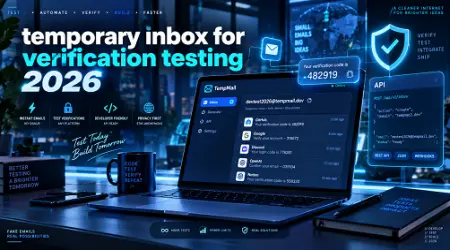
- Is there an API so your automation script can fetch the latest OTP code?
- Does the site inject ads or trackers that might bloat your test results?
- Is the service on any DNS blacklists that could cause false positives?
If you need API access, providers such as Mailinator, EmailOnDeck, or Temp-Mail’s paid tier give you JSON endpoints that return messages in milliseconds—perfect for headless browser tests.
How to Integrate Temporary Email Into Automated Test Suites
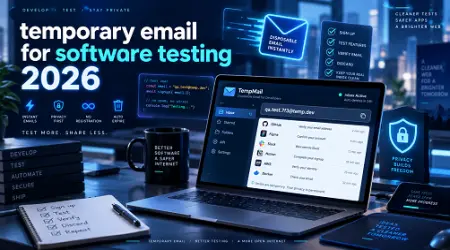
Selenium, Cypress, Playwright—pick your weapon. The flow is almost identical:
- Call the temp provider’s API to generate a unique address.
- Store that address in a variable.
- Fill the signup form using the variable.
- Poll the same API for the latest email containing “verify” or “OTP.”
- Extract the link or six-digit code with a regex.
- Click or type the code, continue the test.
- Assert that the backend registers the user as “email confirmed.”
Pro tip: add a five-second buffer before polling. SMTP can be moody, and you don’t want flaky tests that fail because the message arrived at 4.9 seconds instead of 4.5.
Manual Testing? You Still Win
Even if you’re clicking around like a civilian, disposable mail helps:
- Test multi-language welcome emails: German temp inbox, French, Japanese—no clutter.
- Check unsubscribe links without risking your primary address.
- Verify social-login flows (Google, Apple, Facebook) that still demand an email backup.
- Demo a product to stakeholders on Zoom; create an account live without revealing internal domains.
Security & Ethics: Staying on the Right Side of the Fine Print
Let’s kill the myth: temporary email is not a tool for fraud. It’s a tool for privacy. Still, follow these guardrails:
- Read the app’s Terms of Service. A fintech wallet that demands KYC might blacklist temp domains—respect that.
- Don’t use disposables for production purchases you may need to return (you’ll lose the receipt).
- Never route sensitive personal data (SSNs, medical info) through a public inbox someone else might refresh.
- Clean up after yourself. If the provider auto-deletes after 24 hours, you’re golden; if not, hit the delete button.
Remember, GDPR’s “privacy by design” principle loves disposable data. Using it can actually strengthen compliance, provided you document the short lifespan in your test plan.
Common Pitfalls (and the One-Liner Fixes)
Pitfall: Verification email never arrives.
Fix: Check if the service blocks “role-based” aliases like “test@” or “noreply@”; switch to a random string.
Pitfall: Provider’s domain is on a DNSBL.
Fix: Keep a fallback list of five reputable services; rotate.
Pitfall: CAPTCHA on the temp mail site slows you down.
Fix: Pay $5 for an API key—your hourly rate is worth more than the coffee break you’re burning.
Pitfall: Client wants to re-test the same account next month.
Fix: Use a 30-day burner like Burner Mail or SimpleLogin instead of a 10-minute inbox.
Real-World Scenario: Testing a Ride-Share Promo
Imagine you need to verify that new users get “$5 off first three rides.” You create three temp addresses, sign up, apply the code, and complete dummy rides in a staging environment. You confirm the discount applies, the receipt email arrives, and the promo expires after three trips. Then you wipe the inboxes. No risk of polluting production analytics, no leftover accounts, and your personal Gmail isn’t flooded with “Take another ride this weekend!” nudges for the rest of time.
SEO Corner: Synonyms & LSI Keywords You’ll See Naturally
Throughout this guide we’ve slipped in related phrases: disposable email, throwaway address, burner mailbox, short-term inbox, 10-minute mail, email alias, QA testing, automation, OTP verification, signup flows, spam prevention. Google’s algorithm is smart enough to connect the dots; readers stay happy because the language feels human, not stitched together by a keyword-stuffing robot.
External Resource We Trust
For an up-to-date list of disposable domains currently active, the open-source project “disposable-email-domains” on GitHub is maintained by thousands of developers. It’s a handy reference if you ever need to blacklist (or whitelist) temp providers in your own app. (Yes, the irony is delicious: sometimes you block the very tool you also use.)
Quick-Start Cheat Sheet
- Need 50 addresses in two minutes? → Temp-Mail.org bulk generator.
- Need API + webhooks? → Mailinator paid tier.
- Need 30-day lifespan? → Burner Mail browser extension.
- Need to send outbound mail? → Guerrilla Mail “Compose” feature.
- Need to look corporate? → SimpleLogin alias on your own subdomain.
FAQs – The Questions Everyone Asks Right After “Is This Legal?”
Q1. Will the temp address still work if the app delays the email by an hour?
Most free services recycle after 10–60 minutes. Pick a provider that lets you extend lifetime or choose a 24-hour inbox.
Q2. Can apps detect that I’m using a disposable email?
Some maintain blocklists. If detection is a concern, use a premium alias service on a private domain.
Q3. Is it safe to click verification links in a public temp inbox?
For generic tests, yes. For banking or health apps, no—use a private burner instead.
Q4. Do temporary emails support attachments?
Many do, up to a size limit (often 10 MB). Check the provider’s FAQ before you test that “upload avatar” flow.
Q5. Can I reuse the same temp address later?
Usually no; once it expires, someone else might claim it. Treat it as single-use unless the service explicitly offers “renew.”
Q6. Does using disposable mail violate GDPR?
On the contrary, it can help you comply by minimizing personal data. Just document your test data lifecycle in your DPIA (Data Protection Impact Assessment).
Conclusion – Your Inbox Deserves a Vacation
Testing apps and websites should be about squashing bugs, not drowning in follow-up newsletters. A temporary email address is the cheapest, fastest QA tool you never budgeted for. Spin one up, run your test, watch it vanish—like a magic trick that keeps your primary inbox blissfully quiet. Next time a product manager asks, “Can we create 100 users for load testing?” you’ll smile, open a new browser tab, and generate as many inboxes as there are coffees in the office kitchen. Your future self (and your spam folder) will thank you.