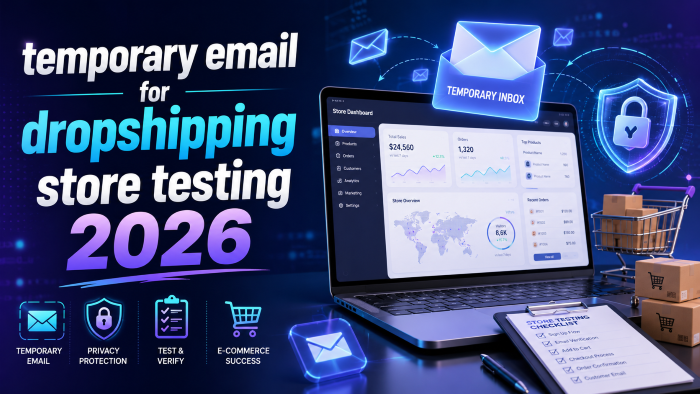
The Ultimate Guide: Using a Temporary Email for Dropshipping Store Testing 2026
Launch day is finally here. You’ve spent weeks agonizing over product photos, dialing in your ad creatives, and tweaking your storefront. You flip the switch, the traffic starts rolling in, and then... nothing. Crickets.
You check your analytics. People are adding items to their cart, but they aren’t buying. Why?
Because your checkout page is throwing a silent error, and your automated welcome discount—the one you promised in your ads—is landing straight in the spam folder.
If you had properly tested your store as a customer, you would have caught this. In my experience, relying on your personal Gmail to test your own store is a rookie mistake. That’s why having a strategy for a temporary email for dropshipping store testing 2026 is absolutely non-negotiable.
In this comprehensive guide, we are going to break down exactly how to use disposable inboxes to bulletproof your customer journey, catch hidden bugs before you waste ad spend, and optimize your backend automations like a seasoned eCommerce veteran.
The Hidden Danger of Testing with Personal Emails
Most beginners finish setting up their store, add a product to the cart, and type in their personal email address to see if the checkout works.
Here is what most people don’t realize: doing this once or twice might seem fine, but building a profitable store requires testing dozens of scenarios.
If you use your primary email, you instantly pollute your own customer data. Your analytics get skewed. Your lifetime value (LTV) metrics become inaccurate. Worse, your personal inbox becomes a nightmare of test receipts, abandoned cart reminders, and shipping updates.
Why You Need a Dedicated Temp Mail for Dropshipping
When you use a temp mail for dropshipping, you keep your personal life separate from your QA testing environment. You can act like a brand-new, anonymous user every single time you navigate your site.
This is the only way to accurately test:
- Welcome series automations
- Post-purchase upsell triggers
- Dynamic pricing algorithms
- First-time customer discount codes
- Shipping rate calculations based on fresh IP and user data
Using a disposable email for store testing guarantees that the system treats you exactly how it will treat your actual paying customers. No cached data, no saved cookies, no biased algorithms.
Anatomy of the Perfect Temporary Email for Shopify Testing
Not all temporary emails are created equal. If you are doing basic temporary email for Shopify testing, you might be tempted to use one of those free "10-minute mail" websites.
Don't do it.
Dropshipping test automations require time. If you have an abandoned cart sequence set to trigger after 4 hours, and a follow-up email set for 24 hours, a 10-minute inbox will vanish before you can verify if your automated flows are actually working.
What to Look for in an eCommerce QA Testing Email
If you want to do this right, your test email address for dropshipping needs a few specific features:
- Extended Lifespan: The inbox needs to stay alive for at least 48 to 72 hours. You are testing entire customer journeys, not just instant gratification.
- Inbox Accessibility: You need to be able to click links inside the emails to verify order status pages and tracking integrations.
- Multiple Addresses: You will want to generate a new address for every specific scenario (e.g., one for desktop checkout, one for mobile checkout).
- Spam Filter Visibility: A good private email testing tool will tell you if your store's emails are landing in the primary inbox, the promotions tab, or the dreaded spam folder.
When you use a proper temp email for eCommerce testing, you aren't just checking if the email sends. You are verifying its deliverability and formatting.
See here………..How to lose weight without dieting
Step-by-Step: The Ultimate Store Testing Protocol
After working with dozens of high-volume stores, I’ve developed a strict pre-launch protocol. Never turn your ads on until you have run through these exact steps using a fresh temporary inbox for online store testing.
Step 1: The Initial Signup and Welcome Flow
Start by visiting your store from an incognito browser. Wait for your pop-up to trigger.
- Enter your temporary email for signup testing.
- Verify that the success message appears correctly.
- Open your disposable inbox and time how long it takes for the welcome email to arrive.
- Click the discount code link in the email and ensure it automatically applies at checkout.
Step 2: The Cart Abandonment Sequence
This is where stores lose the most money.
- Generate a brand new disposable email for checkout testing.
- Add your most popular product to the cart.
- Proceed to the checkout page, enter the fake email, and fill in a shipping address.
- Close the browser completely.
- Monitor your temporary inbox over the next 24 hours to ensure your Klaviyo or Omnisend flows are firing exactly on schedule.
Step 3: The Complete Purchase and Order Confirmation
Now it’s time to simulate a real buyer.
- Use a fresh test email address for dropshipping.
- Go through the entire checkout process.
- Use a test credit card (Shopify provides these natively in their payment gateway settings).
- Complete the purchase.
- Immediately check your temp mail for order confirmation testing. Make sure the branding looks perfect, the legal links are present, and the receipt accurately reflects the tax and shipping rates.
Step 4: The Backend Sync (AliExpress, DSers, AutoDS)
This is specific to dropshippers. Once the fake order is placed, go to your fulfillment app.
Does the dropshipping test account email sync properly to your supplier? If your supplier uses this email to send shipping updates, you need to ensure the data formatting didn't break during the transfer.
See here………..Th13 most powerful war base Proven Layouts + Deep Defense Guide (2025)
Advanced Secret Hacks: Building Your Own Private Testing Environment
Here is a secret that the massive eCommerce brands use, and it is a game-changer for serious dropshippers.
Instead of relying on public temporary email sites (which often get blacklisted by Shopify or WooCommerce as spam), you can build your own private email testing tool for almost zero cost.
The Catch-All Domain Strategy
Instead of Googling "fake email for website testing," go to a budget domain registrar and buy a cheap domain for a few dollars (e.g., mystore-qa-testing.com).
Set up email hosting (many affordable shared hosting plans include this for free) and enable a feature called "Catch-All Routing."
A catch-all setting means that any email sent to that domain will be routed into one master inbox.
Why is this powerful?
Because now, you can make up a new temporary email for WooCommerce testing on the fly without having to generate anything.
- You can use [email protected].
- You can use [email protected].
- You can use [email protected].
All of these will instantly funnel into your one master inbox. This gives you an unlimited, highly organized disposable inbox for dropshipping business needs. It looks entirely legitimate to your store's backend, it bypasses spam filters, and you retain total control over the testing environment.
This small investment easily pays for itself when it prevents a broken email flow from costing you hundreds in lost sales. (Pro tip: if you use a premium domain or hosting service to set this up, look for ones that offer straightforward catch-all forwarding to keep it simple).
Common Mistakes eCommerce Testers Make in 2026
Even with the best tools, human error can ruin your data. Avoid these pitfalls when setting up your store.
Mistake 1: Testing on the Same IP Address
If you run five checkout tests in a row from your home WiFi network, Shopify's fraud algorithms might flag your session. Even worse, your email marketing software might recognize the IP and merge the profiles, ruining your automation tests. Always clear your cookies, use incognito mode, and ideally, toggle a VPN when cycling through temporary emails.
Mistake 2: Forgetting Post-Purchase Upsell Flows
Many store owners check the order confirmation and stop there. But what about the upsell email that triggers 3 days later? If your temp inbox expires in 60 minutes, you will never see how your cross-sell emails are rendering. Always use an extended-life temporary email.
Mistake 3: Ignoring Mobile Responsiveness in the Inbox
You designed your store for mobile, but did you check how your automated emails look on a phone screen? Send your test emails to a disposable inbox that you can access via your mobile browser. Huge logos and tiny fonts in your shipping confirmation emails will destroy customer trust instantly.
Real-World Scenario: The $5,000 Formatting Glitch
Let me share a quick story from a recent consultation. A client was running a highly profitable TikTok ad campaign for a tech gadget. The frontend was converting beautifully, but they were getting buried in customer service complaints.
Customers were furious, claiming they never received their order confirmation or tracking numbers.
We ran an audit using a dedicated eCommerce QA testing email. Within ten minutes, we found the problem. A recent update to their theme had caused a script conflict. The store was passing the customer's email address to the fulfillment app with a blank space at the end of the string (e.g., [email protected] ).
Because of that invisible space, the fulfillment software couldn't read the address and silently dropped all outgoing tracking emails.
By simply using a fake email for website testing and following the data through the entire funnel, we spotted a glitch that was costing them thousands in chargebacks and angry reviews. We fixed the script, and the complaints stopped overnight.
This is why you test.
Pros and Cons of Using Disposable Inboxes for Store Testing
To give you a clear picture of what to expect, here is a breakdown of the realities of using these tools.
The Pros
- Clean Data: Keeps your analytics, Facebook Pixel, and Google Tag data free from internal testing noise.
- Unlimited Scenarios: Allows you to break your site on purpose to see how the system handles edge cases.
- Cost-Effective: Most public temporary email sites are 100% free.
- Security: Protects your personal data from being exposed on third-party fulfillment apps during the testing phase.
The Cons
- Short Lifespans: Public temp mails often delete messages too quickly to test long-term email sequences.
- Blocked Domains: Some platforms actively block known disposable email domains to prevent spam, requiring you to find fresh services.
- No Reply Capability: Many free temp inboxes only let you receive mail. If you need to test your customer service ticketing system by replying to an email, you'll need a more advanced tool or your own catch-all domain.
The Essential Checklist Before Hitting "Publish"
Don't launch blindly. Print this out, tape it to your monitor, and do not spend a single dollar on ads until you have verified every single step using a disposable inbox.
- The Newsletter Sign-up: Did the discount code arrive instantly? Is the code valid?
- The Abandoned Cart: Did the email trigger at the correct interval? Does the link rebuild the cart perfectly?
- The Order Confirmation: Does the receipt look professional? Are the taxes and shipping accurate?
- The Fulfillment Sync: Did the supplier receive the order with the correct temporary email attached?
- The Shipping Update: When you mark the order as fulfilled in Shopify, does the tracking email look good on a mobile device?
- The Customer Service Test: Reply to the automated receipt. Does it go to your correct support desk, or does it bounce back into the void?
Frequently Asked Questions (FAQs)
Can Shopify detect if I am using a temporary email address?
Yes, Shopify's native fraud analysis tools often flag well-known disposable email domains. For testing purposes, this is usually fine since you are using a test gateway anyway. If you want to bypass this entirely, use the custom catch-all domain method mentioned earlier.
How long do temp mails for dropshipping usually last?
It depends on the service. Standard free tools often clear out in 10 to 60 minutes. For eCommerce testing, look for services that allow you to recover the inbox or keep it active for at least 3 to 7 days.
Should I use a temp email to sign up for my actual Shopify or WooCommerce account?
Absolutely not. Your main store account must be tied to a highly secure, permanent, business-grade email address (like Google Workspace). Temporary emails are strictly for testing the front end of your store as a customer.
What is the best way to test SMS marketing along with emails?
Temporary phone numbers exist, but they are highly unreliable and often blocked by SMS marketing apps like SMSBump or Klaviyo. For SMS, it is actually better to use your real phone number or a cheap prepaid SIM card dedicated to testing.
Why are my test emails going to spam?
If you are sending emails to a temporary inbox and they land in spam, it means your store’s domain reputation is low, your SPF/DKIM records are not set up properly, or your email content looks suspicious. This is a massive red flag that you must fix before launching.
Can I test WooCommerce plugins with temporary emails?
Yes. In fact, a temporary email for WooCommerce testing is highly recommended. Because WooCommerce relies heavily on third-party plugins for SMTP and email delivery, conflicts are common. Testing ensures your chosen SMTP plugin is routing mail correctly.
Final Thoughts: Treat Testing Like Marketing
Most beginners view store testing as a boring chore. They want to rush through it to get to the fun part: running ads and making money.
But experienced dropshippers know the truth. Testing is marketing.
Every broken link, every ugly unformatted email, and every delayed shipping notification actively drains your profit margin. By implementing a solid system for using a temporary email for dropshipping store testing 2026, you are building a watertight funnel that turns clicks into cash.
Stop guessing. Start testing. Build your catch-all domain, run through the checklist, and launch with total confidence.
What is the most frustrating bug or glitch you've ever discovered while testing your eCommerce store? Let me know in the comments below—I read every single one!