The Ultimate Guide to Finding the Best Temp Email for Form Testing 2026 (Stop Spamming Your Real Inbox!)
I recall a certain time when I recognized that my personal inbox was ruined. I was doing a really significant launch for a client and testing their new onboarding process. I wanted to witness the welcome sequence and so did it on my real email. Then I wanted to try out a bug fix and tried [email protected]. At the end of the week, I had come up with more than 60 variations of my own address.
I really had a bunch of dummy receipts, fake password resets, and automated onboarding drips just flooding my inbox. If my life depended on it I couldn't find any actual client message.
Anyone building and testing or managing websites, knows my pain. Using your own or business email address to check sign ups and contact forms are beginner's errors. In this year 2026, characterized by intricate automated systems, the temporary email for form testing has become more than a luxury; it's a necessity for anyone aiming to maintain their sanity.
Today, we're going to dissect everything you need to know about establishing a temporary e-mail for testing. We'll discuss the secret features that most forget, the insanely specific configurations that QA pros employ to automate their process and how to select the right software testing email tool without breaking the bank.
Why Every Developer and QA Tester Needs a Temporary Inbox
What most people don't know is that testing should not only involve your "Submit" button. It's about assuring the full data path. Is confirmation email received? Can you click on the verification link? Does HTML formatting not work on mobile?
It's not a good choice to use your primary email for a number of reasons. Pollution of own data in the first place. If you are observing user analytics or CRM activity, putting fifty "ghost" users into your live CRM system distorts your data. Secondly, there are limits to deliverability. If you blast a ton of test emails to the same domain too soon, then you can end up triggering spam filters and it can be really devastating to your email verification process.
You can use a separate, one-time inbox for developers to separate your testing environment. It serves as a sandbox. It can be "blasted" with hundreds of test registrations, password resets, and automated receipts and at the end of the day just be wiped clean.
The Evolution of the Test Email Address
Years ago, developers relied on simple fake emails—addresses that didn't actually exist, just to bypass mandatory form fields. But today, a fake email for testing isn't enough. Modern applications require double opt-ins. You actually have to receive the email, open it, and click a link to proceed.
This is where a modern disposable inbox changes the game. It gives you a real, functioning inbox that exists just long enough to catch your test messages, allowing you to complete complex QA loops without cluttering a permanent account.
The Hidden Tech Hacks of a Modern Temp Mail for Testing Forms
If you think a disposable email is just a basic webpage that refreshes to show new messages, you’re missing out on the best parts. In my experience, the real power of these tools lies in the hidden features that save you hours of manual clicking.
Here are a few advanced tricks you should be looking for in a temp email tool this year:
- API Automation: The best tools don't require you to manually check a browser window. They offer an API. You can write a simple script in Cypress or Selenium that fills out your form, pings the temp email API, retrieves the verification code from the incoming message, and pastes it into your app—all automatically.
- Catch-All Domains: Instead of generating a new random address every time, you configure a catch-all testing domain. Any email sent to [anything]@your-test-domain.com routes to one master dashboard. You can use [email protected], and immediately check the master inbox.
- HTML & Spam Analysis: A high-quality QA email testing setup doesn't just show you the text of the email. It analyzes the hidden headers. It tells you if your server’s SPF or DKIM records are failing, and shows you exactly how the HTML will render across different devices.
See here………How to learn English fast for beginners
Real Email vs. Disposable Inbox: A Quick Breakdown
To make it incredibly clear why a dedicated solution is better for your workflow, let's look at a direct comparison.
Step-by-Step: How to Use a Temp Email for Signup Testing Like a Pro
If you’ve never integrated a proper temp email into your workflow, the process is surprisingly simple. Let’s walk through a standard website form testing scenario, such as checking a new SaaS user registration flow.
Step 1: Generate Your Temporary Email Address
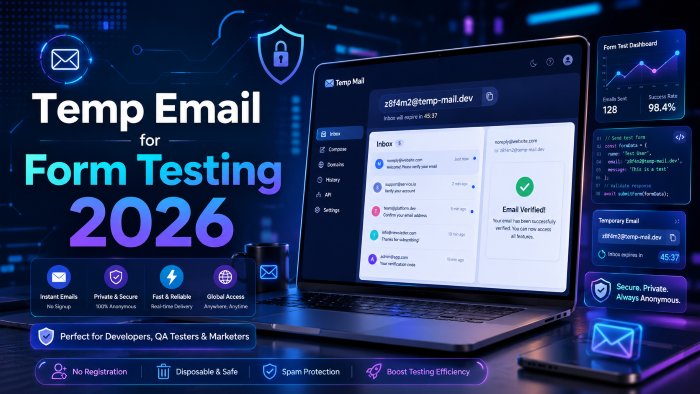
Navigate to your chosen testing tool. If you are doing a quick manual test, a simple no sign-up temp email generator will instantly provide you with an address (e.g., [email protected]). Copy this directly to your clipboard.
Step 2: Execute the Form Testing
Go to your application's staging or development environment. Fill out the registration form using the temporary address. Use a distinct, easily recognizable testing name (like "QA Test Alpha") so you can easily spot this record in your database later. Hit submit.
Step 3: Verify the Delivery Route
Flip back to your temporary inbox. The confirmation email should arrive within seconds. If it doesn't, you immediately know you have a server-side sending issue.
Step 4: Inspect the Payload
Don't just click the link. Open the email and look at the rendering. Are the brand logos displaying correctly? Are the UTM parameters on the buttons functioning? Once you've verified the visual components, click the verification link to ensure the loop closes successfully in your application.
Step 5: Wipe and Repeat
Once the test is complete, most disposable inboxes allow you to delete the address with a single click, completely erasing the data. You are now ready to generate a new address for the next test scenario.
The Best Software Testing Email Tools to Consider
If you're seeking a secure environment, there are some platforms that consistently provide a dependable and secure setup. I don't list every tool that's out there—well, not every one anyway—but I do want to emphasize the kinds of tools that add value to a professional workflow.
Simple, free web-based generators will do if you're a one-man team that tests forms on your website occasionally. They will provide you with a temporary inbox for the next 10 minutes, enough for you to click the confirmation link.
If you're a growing agency, eCommerce brand, or SaaS provider, however, spending on a top-notch email testing suite is one of the best ROI choices you could make. The tools that provide domain testing, API and team workspaces typically run a few dollars per month but save hours and hours of tedious manual effort!
Pro Tip: Many of these awesome test environment providers have quite generous free tiers, and they often include API access! When you find one that works just as you want, it may be a no-brainer to upgrade to their paid version to access more APIs or more team members, or whatever you need, and it will typically pay for itself in developer time saved within your first week.
The Biggest Mistakes People Make with Form Testing Emails
After working with dozens of development teams, I see the same recurring errors when it comes to QA email testing. Avoid these pitfalls to keep your testing environments accurate and secure.
1. Testing in Production with Public Inboxes
This is a massive security risk. If you are testing a password reset function on a live, production database using a highly public temp email address, anyone who happens to monitor that public inbox stream could potentially intercept the reset link and gain access to your system. Always use private, secure testing tools for sensitive data.
2. Forgetting About Domain Blacklists
Many major software platforms actively block known disposable email domains to prevent spam signups. If you are testing an integration with a strict third-party CRM, they might reject your form testing email outright. In these cases, you need a testing tool that allows you to configure a custom, private domain.
3. Ignoring Email Headers
It's great if the email arrives, but if it arrives because your testing tool has exceptionally loose spam filters, you aren't getting a true picture. Always check the headers to ensure your DKIM and SPF records are passing. Just because a disposable inbox caught the message doesn't mean Gmail or Outlook won't throw it in the junk folder.
See here………TH13 Best Home CoC Base
Real-World Case Study: Saving 10 Hours a Week on QA
I had the opportunity to consult with one of the medium-sized eCommerce brands a few years back. They had 5 conditional email triggers in their checkout process: order confirmation, shipping delay, abandoned cart, digital download delivery and a request for a post purchase review.
Each update to the checkout code the QA team would trigger these events manually on a Friday with a number of different Gmail addresses. It was tedious, error-prone and very slow.
We have completely redesigned their system by embedding a special software testing email tool by using an API. We created a script that simulated a purchase, retrieved the temporary email inbox, read the receipts and validated that there was the correct price and links.
The result? Ten hours of clicking and box refreshing was previously reduced to a two minute automated script running in the background. It's the real magic of going beyond simple manual testing.
Frequently Asked Questions (FAQs)
What is a temp email for form testing?
It is a short-lived, disposable email address used by developers and QA testers to receive automated messages, verify signups, and test system workflows without using a real, permanent personal inbox.
Is it safe to use a temporary email address?
Yes, for testing purposes in development or staging environments, it is perfectly safe. However, you should never use a public disposable inbox to receive sensitive information, personal data, or real password resets.
Can a temp mail for testing forms send emails too?
Most basic disposable inboxes are receive-only. However, advanced software testing email tools do allow you to simulate sending to test your application's incoming email parsers and webhook integrations.
Will third-party APIs block my test email address?
It depends on the domain. Many public disposable domains are on global blacklists. If you need to test integrations with strict platforms, you should use a testing tool that allows you to connect a private, verified custom domain.
How long does a no sign-up temp email last?
Typically, free disposable emails last anywhere from 10 minutes to 24 hours before the inbox and its contents are permanently deleted by the server.
Conclusion & Your Next Steps
You don't have to let go of your neat inbox in order to test your site's functionality. You're not only getting a dedicated temp email to test forms 2026 but are also simplifying your operations, safeguarding your data analytics against fake accounts, and unlocking powerful automated testing and QA practices.
If you're an individual website owner looking to run a quick manual check on a new contact form, or you're a senior developer who is creating an advanced API script to confirm ecommerce receipts, there's a tool out there that will work for you. Say goodbye to the +1 alias trick and hello to a better testing environment today.
The turn to you: Ever accidentally blast your real customers with a huge volume of test emails due to a QA mix-up? Tell about your best (or worst) testing horror story in the comments below and tell me which temporary inbox method you're using to avoid it!