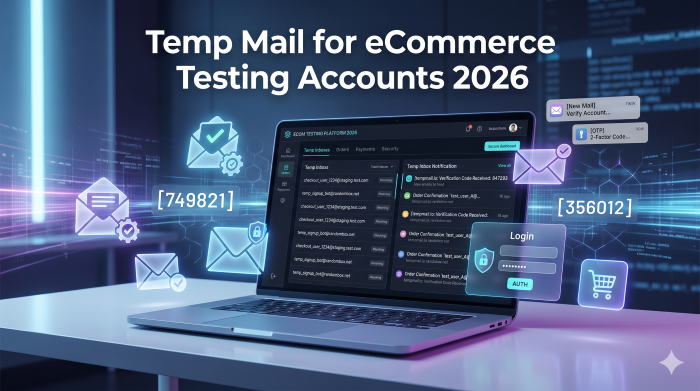
The Ultimate Guide to Using Temp Mail for eCommerce Testing Accounts 2026
Have you ever launched an online store, watched the first real customer place an order, and then felt your stomach drop when they emailed you to say, "I never got my receipt"?
I have. It’s a terrible feeling. When you’re building an online business, testing the purchase flow is non-negotiable. But testing every single email trigger—signups, password resets, abandoned carts, order confirmations, and shipping updates—can quickly turn your personal inbox into a chaotic mess.
This is exactly why you need temp mail for eCommerce testing accounts 2026. A disposable inbox allows you to simulate the entire customer journey thousands of times without polluting your actual email or relying on clumsy aliases like [email protected].
In my experience, moving from manual email checking to a dedicated disposable email for eCommerce testing completely changes how fast you can build and release updates. Whether you are a solo Shopify store owner, a freelance developer, or part of a massive QA team, this guide will walk you through exactly how to set up, automate, and scale your email verification testing this year.
Why Your Online Store Needs a QA Testing Temporary Inbox
Testing an eCommerce site sounds simple until you realize how many emails a single customer receives. If you just test one order, sure, you can use your own email. But what happens when you need to test five different checkout scenarios across three different browsers, and then verify the abandoned cart sequence that triggers two days later?
What most people don't realize is that relying on traditional email providers for QA testing is a massive bottleneck. You hit rate limits. Emails get grouped into long, confusing threads. Spam filters catch your test receipts, making you think your site's code is broken when it isn't.
Here are the biggest reasons why using a temporary email service 2026 is critical for your tech stack:
1. Keeping Test Data Clean and Isolated
When you use a fake email for website testing, you keep your production environment completely separate from your staging environment. You don't have to worry about accidentally mixing a real customer’s support ticket with a test order receipt. Every test user gets an isolated inbox.
2. Bypassing Anti-Spam Limits
Providers like Gmail or Outlook are designed for humans. If your automated test script creates 50 test user accounts for online store validation in three minutes, Gmail will block you. A dedicated disposable email address for developers is built to handle massive volumes of incoming mail without rate-limiting you or throwing up CAPTCHAs.
3. Unblocking Automated Workflows
Modern eCommerce website QA tools rely on automation. You want your CI/CD pipeline to create an account, purchase a product, catch the OTP (One-Time Password) from the email, and verify the receipt automatically. A robust temp email for QA testing provides an API that lets your automated scripts read incoming emails instantly.
How Temporary Email Accounts Actually Work
If you're new to the concept, a temporary email for testing might sound sketchy. We often associate "burner emails" with people trying to bypass free trial limits on Netflix. But in the software development world, these tools are highly specialized infrastructure.
Here’s the basic mechanics of how they operate:
When you use a platform designed for QA, the inboxes technically already exist. You don’t need to register an account or set a password for the test email. You just send an email to any random string of characters (for example, [email protected]), and the server catches it.
The moment you want to check that email, you ping the service's website or API, ask for the messages sent to that specific address, and it shows you the inbox. After a set period (usually a few hours or days), the system wipes the inbox clean. No passwords to remember. No storage limits to worry about.
The Best Temporary Email Services for eCommerce Testing in 2026
After working with dozens of QA teams and launching multiple eCommerce platforms, I’ve seen which tools actually hold up under pressure. The landscape has shifted significantly going into 2026, with AI integration and better API features becoming the standard.
Here are the top online store testing tools for email validation right now:
1. Mailinator
If you are doing enterprise-level QA testing, Mailinator is the gold standard. It has been around for years, but their 2026 Teams platform is incredibly powerful. They allow you to route emails and SMS messages, meaning you can test two-factor authentication (2FA) flows flawlessly.
You can use their public inboxes for free, but their paid tiers offer private domains, webhook support, and API integration. If your QA automation runs on Cypress, Playwright, or Selenium, Mailinator is built to plug directly into those frameworks.
2. Mailsac
Mailsac is arguably the best disposable email for eCommerce testing if you want a balance between ease of use and developer features. They allow you to create spontaneous inboxes based on whatever criteria you want. You can organize your testing with subdomains (e.g., [email protected]), which is a lifesaver when you have multiple developers working on the same eCommerce project simultaneously.
3. Temp-Mail-AI
For those who need a rapid, safe temp mail for developers without setting up complex APIs, Temp-Mail-AI has introduced some impressive features this year. They use machine learning to filter out actual spam from your test environments. While it's more geared toward fast, manual testing, it’s an excellent, free tool for eCommerce store owners who just need to quickly verify a coupon code sequence or a signup flow without logging into a massive dashboard.
See here………….How to lose weight without dieting
Step-by-Step: Setting Up Test User Accounts for Online Store QA
Let’s get practical. How do you actually implement this when testing your Shopify, WooCommerce, or custom-built checkout? Here is my exact workflow for setting up an eCommerce account testing email.
Step 1: Map Out Your Email Triggers
Before you generate a single test email accounts for eCommerce, list every email your store sends. A standard list looks like this:
- Account registration confirmation
- Double opt-in verification
- Password reset link
- Order confirmation/receipt
- Shipping notification
- Abandoned cart reminder (usually sent 4 to 24 hours later)
- Post-purchase review request
Step 2: Choose Your Temp Mail Strategy
Decide if you are doing manual testing or automated testing. If you are a store owner manually checking a new theme, a free web-based temp inbox works fine. If you are a developer writing an end-to-end test, you need a service with API access and a private domain.
Step 3: Generate Dynamic Email Addresses
Never use the same test email twice if you can avoid it. Most testing platforms let you use a wild card approach.
For example, I will use a timestamp in my email address:
By dynamically generating the email based on the current date and time, I guarantee that every test starts with a completely empty inbox. This prevents my test script from accidentally reading an order receipt from a test I ran yesterday.
Step 4: Run the Transaction
Go to your eCommerce site, add a product to the cart, and proceed to checkout. When prompted for an email, paste your dynamically generated temp email address. Complete the purchase using a test credit card (like the standard Stripe 4242 testing card).
Step 5: Verify the Inbox
Switch over to your disposable inbox for signup testing. You should see the order confirmation arrive almost instantly. Check the following:
- Did the email arrive within the expected timeframe?
- Is the formatting correct on both desktop and mobile views?
- Are the dynamic variables (like the customer's name and order number) populating correctly?
- Do the tracking links point to the correct URL?
Real-World Case Study: Fixing a Broken Password Reset Flow
Let me share a story that highlights why this is so important. Last year, I was consulting for a mid-sized apparel brand. They were getting a flood of customer service tickets from users complaining that they couldn’t log into their accounts and the password reset wasn't working.
The development team swore the feature worked. They had tested it. But they had tested it using their own corporate email addresses.
We decided to run an automated suite using a QA testing temporary inbox. We generated 100 fake email addresses, created accounts, and triggered the password reset.
What did we find? The email delivery service was rate-limiting identical emails sent in rapid succession. The developers didn't catch it because they only ran the test once or twice. When real users were hitting the reset button during a big sale, the server throttled the outgoing emails.
By switching to a scalable temporary email service, we could simulate high-load events and optimize the server settings to handle the spike. It saved the client thousands of dollars in lost sales and customer service hours.
Pros and Cons of Using Disposable Inboxes for QA
Like any tool, using a temp email for QA testing has its trade-offs. Here is an honest look at the advantages and limitations.
5 Common Mistakes When Using Fake Email for Website Testing
Even experienced developers make errors when setting up their testing environments. Avoid these common pitfalls to ensure your QA process is airtight.
1. Using Public Inboxes for Sensitive Staging Data
If you use a free, public service like [email protected], anyone in the world who types "test1" into Mailinator can see the emails. Never send staging database dumps, API keys, or unreleased product designs to a public temporary email. Always upgrade to a private domain for sensitive eCommerce website QA tools.
2. Not Testing on Real Mobile Devices
You might check the temporary inbox on your desktop browser, see that the HTML receipt looks great, and call it a day. But over 60% of eCommerce traffic is mobile. You must verify how those emails render on smaller screens. The layout that looks perfect on a 27-inch monitor might be completely broken on an iPhone.
3. Forgetting About Spam Filters
A temporary email for testing will happily accept anything you send it. But real providers like Gmail and Yahoo have strict spam filters. If your eCommerce store isn't properly configured with SPF, DKIM, and DMARC records, your beautifully tested emails will land straight in your customers' junk folders. Use tools like Mail-Tester alongside your disposable inbox to check your spam score.
4. Reusing the Same Email Address
As mentioned earlier, reusing [email protected] for every transaction will create a nightmare of a thread. If your automated test looks for the subject line "Your Order Receipt," and there are fifty emails with that subject line in the inbox, the script might read the oldest one and falsely pass the test. Always use unique identifiers for each run.
5. Ignoring the "Unsubscribe" Flow
When testing, we focus heavily on signups and purchases. But legally, you must test your opt-out process. Use a disposable email address for developers to subscribe to your marketing newsletter, click the unsubscribe link in the footer, and then verify that the system actually stops sending mail to that address.
See here………….Th13 most powerful war base Proven Layouts + Deep Defense Guide (2025)
Frequently Asked Questions (FAQs)
What is a disposable email for eCommerce testing?
It is a short-lived email address that requires no registration or passwords, used by developers and QA testers to safely test account creation, order receipts, and automated workflows without cluttering real inboxes.
Is it safe to use temp mail for testing my online store?
Yes, as long as you use a reputable provider. If you are testing sensitive staging environments, you should use a paid service that offers a private domain, ensuring no one else can view your test emails.
Can I use a temporary email to test SMS text messages too?
Yes! Advanced QA platforms like Mailinator now offer disposable SMS numbers alongside email, allowing you to test complex two-factor authentication (2FA) and text-message marketing flows.
Why shouldn't I just use Gmail aliases (like [email protected])?
While Gmail aliases work for a handful of manual tests, they eventually clutter your primary inbox. Furthermore, Google’s anti-spam algorithms will eventually flag and block your IP if you try to automate thousands of rapid emails to a single Gmail account.
How long do emails stay in a temporary testing inbox?
It depends on the provider. Most free services delete emails immediately upon closing the browser or within a few hours. Enterprise testing tools usually retain them for 1 to 7 days to allow for longer automated workflows.
Can I integrate temp mail into my automated CI/CD pipeline?
Absolutely. The best temporary email service 2026 options offer robust APIs. You can write scripts in Selenium, Cypress, or Playwright that create a user, wait for the verification email, extract the OTP code, and input it back into your application entirely automatically.
Final Thoughts and Actionable Takeaways
Testing the communication loop of your online store shouldn't be an afterthought. The emails you send are often the only direct touchpoint you have with your customers after they hand over their credit card. If those emails fail, trust evaporates instantly.
Using a temp mail for eCommerce testing accounts 2026 is the smartest, most scalable way to guarantee your site functions flawlessly under pressure. By isolating your test data, bypassing strict spam limits, and leveraging API automation, you can catch critical bugs long before your customers ever notice them.
Your Action Plan:
- Stop using your personal email for testing today.
- Choose a disposable email platform (like Mailinator for automation or Temp-Mail-AI for quick manual checks).
- Map out every single email trigger on your site.
- Run a full, end-to-end test using unique, dynamic temporary email addresses.
- If you have a development team, mandate the use of a private testing domain to secure your staging data.
If you found this breakdown helpful, what email flow is currently causing the most headaches in your store? Drop a comment or share this guide with your development team so you can finally get your QA process running smoothly.