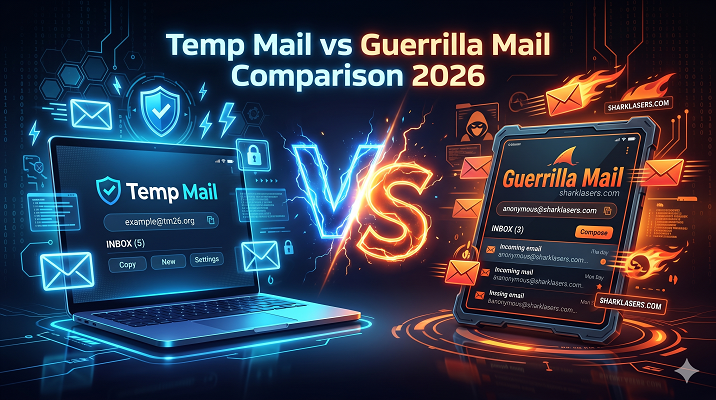
TEMP MAIL VS GUERRILLA MAIL 2026: THE ULTIMATE DISPOSABLE EMAIL COMPARISON
We have all been there. You just want to read a single article, download a free PDF guide, or get your hands on that sweet 15% off coupon code. But right before you can reach the content, a giant pop-up blocks your screen, demanding your email address.
You know exactly what happens next. If you hand over your real email, you are going to be hammered with daily promotional blasts, weekly newsletters, and "special offers" until the end of time. Worse, your address will probably be sold to a data broker, and suddenly you are getting spam about products you have never even heard of.
That is exactly why burner emails exist. But the landscape of disposable inboxes has changed drastically recently. Sites are getting much smarter. They block fake emails faster than ever, using real-time API checks to keep you out. So, if you are looking for the best temporary email services to keep your primary inbox pristine, you have probably narrowed your choices down to two massive players.
In my experience, picking the right tool is no longer just about avoiding spam; it is about actually getting the verification email without being slapped with a red error message.
Let us dive right into the ultimate temp mail vs guerrilla mail 2026 showdown. I am going to break down how they both hold up today, share some hidden features you probably didn't know about, and help you figure out which one is actually worth your time.
WHY YOU STILL NEED A BURNER INBOX IN 2026
What most people do not realize is that an email address functions essentially as a digital social security number now. It connects your online shopping habits, your social media profiles, your banking information, and even your physical location data.
Every single time you hand it over to a random Wi-Fi portal at a coffee shop or a questionable software trial, you are giving away the master key to your digital footprint.
Using a free temporary email generator solves three massive modern problems:
• It kills the spam before it even starts. You get the discount code, the email disappears into the ether, and your personal Gmail remains completely untouched.
• It protects your core identity. If a site suffers a massive data breach (and let's be honest, they all do eventually), the hackers only get a randomized burner address that does not link back to your real name or your reused passwords.
• It bypasses forced registrations. You can test out a brand-new app or service without committing to their ecosystem and getting trapped in their drip-marketing campaigns.
But here is the insider secret. A lot of people just type "fake email" into a search engine and click the very first link. That is a massive mistake. Websites use sophisticated blocklists now. If you use the wrong service, you will just get an annoying notification saying, "Please enter a valid work or personal email address."
That brings us directly to our two heavyweights. Let us do a deep dive into each platform.
GUERRILLA MAIL REVIEW 2026: THE OLD RELIABLE
If you have been navigating the internet for a while, you probably already know Guerrilla Mail. Founded way back in 2006, this service is an absolute dinosaur in the tech world—but I mean that as a massive compliment.
It has not changed its look much over the years, and that is entirely by design. It is barebones, slightly ugly, and incredibly effective.
Guerrilla Mail Features That Actually Matter
The interface looks like it was built during the era of dial-up, but beneath that retro exterior is a powerhouse of utility.
- You Can Actually Send Emails
This is the holy grail. Most disposable email comparison charts miss this fact entirely. Almost every temporary inbox on the internet is "receive only." Guerrilla Mail actually lets you compose and send outgoing messages. You can even attach files up to 150MB. If you need to send an anonymous tip, report a bug without linking your identity to the complaint, or test a server's email routing, this is your go-to digital hack. - Custom Domain Selection
Instead of being locked into one suspicious-looking domain, you get a helpful dropdown menu. You can choose from classic options like sharklasers.com or guerrillamail.com. Switching domains is a crucial tactic when a website tries to block disposable addresses. If one fails, you just pivot to another. - Scrambled Addresses
To add an extra layer of privacy, Guerrilla Mail provides a "Scrambled Address" feature. It masks your inbox ID so that even if someone knows your temporary address, they cannot easily guess the underlying inbox to snoop on your private verification codes.
The Downsides in 2026
After working with hundreds of website backends and deliverability audits, I can tell you the biggest issue with Guerrilla Mail today is its long-standing reputation. Because it is so famous, and because it allows outgoing mail, it is heavily targeted by security filters. A lot of modern software platforms will immediately reject a sharklasers.com address.
Additionally, the inbox only holds emails for one hour before they are permanently deleted. If you need a disposable email for verification that might take a while to arrive, or if you need to click a confirmation link a day later, you are entirely out of luck.
See here……….TH13 Best Home CoC Base
TEMP MAIL REVIEW 2026: THE MODERN SLICKSTER
On the other side of the ring, we have Temp Mail. When people talk about modern, sleek, and fast burner inboxes, this is usually the one they mean. You will typically find it at temp-mail.org or temp-mail.io.
If Guerrilla Mail is a rugged old pickup truck that can haul anything, Temp Mail is a brand-new electric vehicle. It is smooth, heavily optimized, and built entirely for user convenience.
Temp Mail Features That Stand Out
Temp Mail focuses heavily on a frictionless user experience, and it absolutely shows.
- Instant, Frictionless Generation
The second you load the web page, your new email address is already waiting for you. There are no buttons to click to generate it. You just hit the copy icon and paste it into whatever form is currently annoying you. - Mobile Apps and Browser Extensions
This is where Temp Mail truly shines in the modern era. They have a dedicated iOS and Android app, plus excellent Chrome extensions. If you are doing a lot of online shopping on your phone and want to grab those instant discount pop-ups, having the Temp Mail app installed is a total game-changer. It feels like a native part of your operating system. - Premium Options (The Unspoken Reality)
Here is a practical tech tip that ties into how things operate in 2026. Because disposable domains get blocked so frequently, Temp Mail pushes a Premium subscription. It gives you access to private, clean domains that have not been blacklisted yet. While I usually advocate for free tools, if you are a developer testing signup flows or a professional who desperately needs to bypass strict corporate filters, investing in a premium privacy tool can save you hours of sheer frustration. It works incredibly well when paired with other privacy setups.
The Downsides in 2026
Temp Mail is strictly a one-way street. You cannot send emails under any circumstances. It is designed solely to catch incoming spam and quick verification codes.
Also, the free version is heavily ad-supported. Sometimes the display ads can be a bit intrusive, especially when you are viewing it on mobile, which is the inevitable trade-off for a free, high-quality service.
TEMP MAIL VS GUERRILLA MAIL: WHICH IS BETTER?
Alright, let us get down to the actual temp mail vs guerrilla mail which is better debate. To give you a clear, honest answer, we have to look at how they perform across different real-world categories.
Category 1: Bypassing Email Blocks
Winner: Tie (Highly Situation Dependent)
In 2026, companies use advanced API databases to block throwaway emails in milliseconds. Guerrilla Mail’s domains are heavily blacklisted because of its massive legacy. Temp Mail frequently rotates its free domains to stay one step ahead of the blocks, but they still get caught frequently. If you use Temp Mail Premium, Temp Mail wins easily. If you are strictly using free versions, you might have to try both to see which one slips past the specific website's automated defenses.
Category 2: User Interface and Speed
Winner: Temp Mail
There is absolutely no contest here. Temp Mail is visually pleasing, incredibly fast, and even gives you a QR code to easily transfer the address to your phone's camera. It auto-refreshes seamlessly in the background. Guerrilla Mail feels clunky, outdated, and requires manual refreshing to see new messages sometimes.
Category 3: Advanced Functionality and Utility
Winner: Guerrilla Mail
If you are an intermediate user, a web developer, or a hardcore privacy enthusiast, Guerrilla Mail’s ability to actually send emails and attach large files makes it an invaluable digital multi-tool. It is not just a spam catcher; it is a fully functional anonymous communication node.
Category 4: Inbox Lifespan
Winner: Temp Mail
Guerrilla Mail aggressively deletes your messages after exactly 60 minutes. Your inbox address technically lasts forever, but the contents vanish quickly. Temp Mail generally keeps your current session alive as long as you keep the browser window open or the mobile app active, giving you a bit more breathing room if a verification email is delayed by a slow server.
THE DARK HORSE: TEMP MAIL ALTERNATIVES IN 2026
Maybe neither of these quite fits your specific workflow. If you are looking for anonymous email services 2026 style, there are a few other clever workarounds you should know about.
• 10MinuteMail: The classic ticking clock. It gives you exactly ten minutes to complete your task, though you can hit a button to add another ten if you are running late. It forces you to be fast, which is great for quick verifications and keeping server loads light.
• YOPmail: Highly popular in Europe and among developers. The unique thing about YOPmail is that you can make up any address you want on the spot (for example, [email protected]) and then go check the inbox later. The major catch? Inboxes are completely public, so never, ever use it for anything remotely sensitive.
• Email Aliases (The Pro Move): Services like SimpleLogin or Apple's Hide My Email represent the ultimate evolution of this concept. Instead of a temporary web page, they generate unique, random addresses that permanently forward to your real, hidden inbox. If a service starts spamming you, you just turn off that specific alias toggle. It is the best of both worlds and highly recommended for long-term privacy.
HOW TO SET UP A PERMANENT BURNER SYSTEM (ADVANCED DIGITAL HACK)
For those of you who are tired of switching between tabs and hunting for a disposable domain that hasn't been blocked, let me share a digital hack that completely changed how I manage my online presence.
Instead of relying on free temporary email generators, you can create a permanent burner system using a catch-all domain.
Here is how it works: You purchase a cheap, random domain name (something like mymailhub.xyz). You then connect that domain to a basic email hosting service or a forwarding service, and you enable a feature called "Catch-All."
A catch-all setting means that any email sent to [email protected] will automatically land in your one master inbox.
Why is this so powerful? Because you never have to generate an email again. If you are standing in line at a retail store and they ask for your email to send a receipt, you just make one up on the spot: [email protected]. If you are signing up for Netflix, you use [email protected].
Because you own the domain, it will never be blocked by a disposable email filter. And if "[email protected]" suddenly starts receiving spam from third-party marketers, you know exactly who sold your data, and you can create a simple rule to block that specific address forever. It requires a small upfront setup, but it is the ultimate long-term solution for intermediate users.
See here…..How to start a blog that earns money 2026
COMMON MISTAKES WHEN USING FREE TEMPORARY EMAIL GENERATORS
I have seen people make some disastrous errors when dealing with disposable inboxes. Here are the major pitfalls you need to avoid to keep yourself safe.
Mistake 1: Using Them for Financial or Medical Accounts
This should be incredibly obvious, but never use a disposable email for your bank, your crypto wallet, or your healthcare portal. Temporary inboxes are inherently insecure. Many of them can be accessed by anyone who types in the same address hash. If you need to reset a password for a financial account and you do not control the email anymore, you will be permanently locked out of your own money.
Mistake 2: Expecting Them to Last
Do not use a burner for a software subscription you plan to keep using for months. If you forget your password in December, that temporary inbox you created back in May is long gone. You will not be able to recover your account. Burners are strictly for throwaway accounts only.
Mistake 3: Believing You Are 100% Anonymous
A throwaway email protects your primary inbox from spam, but it does not make you a digital ghost. If you send a threatening or illegal email via Guerrilla Mail, law enforcement can and will trace your IP address. If you want true anonymity, you need to route your connection through a strict no-logs VPN and the Tor network before you even open the email generator.
REAL-WORLD CASE STUDY: THE SAAS BYPASS
Let me paint a picture of how this actually plays out in the real world. Let us say you are researching presentation software for work, and you want to try a promising new web app.
You hit their sleek landing page. The button screams: "Start your 14-day free trial!"
You click it. Immediately, they demand a business email.
You open a new tab and go to Temp Mail. You copy the slick, auto-generated address, paste it into the software's signup form, and hit submit.
Instantly, the site throws an error: "Please provide a valid work email address. Disposable domains are not allowed." They are using a real-time validation API to block you at the gate.
Here is the workaround. You pivot over to Guerrilla Mail. You use the dropdown menu to select one of their lesser-known alias domains, maybe something obscure that doesn't scream "burner." You try again.
Boom. It goes through. You check the Guerrilla Mail tab, wait about ten seconds, and the verification link appears. You click it, access the software, test it out for twenty minutes, realize it lacks the features you need, and close the window forever.
You just saved your real inbox from a three-year drip campaign of "Hey, we miss you, please come back!" emails. That is the true power of knowing your tools and knowing how to pivot.
FREQUENTLY ASKED QUESTIONS
To wrap up all the technical details, let us hit some of the most common questions people ask about this entire topic.
Are temporary email services illegal?
No, absolutely not. Using a throwaway address to protect your personal data and avoid spam is completely legal. However, if you use these services to commit fraud, harass people, or bypass legal restrictions, the actions themselves are illegal, regardless of the email platform used.
Can a temporary email be traced back to me?
Yes, if someone with authority really wants to. The services log IP addresses for a certain period to prevent abuse and illegal activity. Your ISP also knows you visited the site. A temp mail protects you from marketers and data brokers, not from a legal subpoena.
Why do websites block temporary emails?
Companies want your real email so they can market to you, track your behavior across the internet, and inflate their "active user" metrics to show investors. Disposable emails ruin their data collection and increase their server bounce rates, so they pay for expensive blocklists to keep them out.
Can I recover an expired temporary email?
In almost all cases, no. Once the session ends or the time limit expires, the inbox and its contents are permanently wiped from the server to make room for new users. This is a deliberate privacy feature, not a bug.
Does Temp Mail or Guerrilla Mail work on mobile?
Yes. Temp Mail has dedicated applications for both iOS and Android which are fantastic and highly rated. Guerrilla Mail works perfectly fine through your mobile web browser, though the retro interface isn't exactly optimized for small touch screens.
THE BOTTOM LINE: WHICH ONE SHOULD YOU CHOOSE?
We have covered a massive amount of ground in this temp mail vs guerrilla mail comparison. So, what is the final verdict for 2026?
If you are a beginner or intermediate user who just wants to read an article hidden behind a forced signup, grab a quick promotional coupon code, or test out a mobile game without getting spammed, use Temp Mail. The interface is beautiful, the mobile app is incredibly convenient, and it gets the job done instantly with zero friction.
If you are a power user, a developer testing backend scripts, or someone who actually needs to send an email or attach a file without revealing your identity, Guerrilla Mail is your undisputed champion. It might look like it belongs in a tech museum, but it has the raw, unfiltered functionality that modern sleek apps constantly strip away.
At the end of the day, your digital privacy is entirely in your own hands. Stop giving away your primary email address to every random website that asks for it. Build the habit of using disposable inboxes, pair them with a good alias manager or a reliable privacy suite, and finally take back control of your inbox.
What has your experience been with burner emails recently? Have you found a secret workaround to bypass strict website filters, or a lesser-known alternative that works better? Drop a comment below and share your best digital hacks with the community.