The Ultimate Guide to Using a Temporary Email for Website Automation Testing 2026
If you have ever launched a new web app only to watch your user registration flow break down on day one, you know the exact kind of panic I am talking about.
A few years back, I was working on a major lead generation funnel. We had spent weeks perfecting the copy, optimizing the landing pages, and setting up complex affiliate tracking. The marketing team pushed the campaign live, traffic flooded in, and our conversion rate sat at an abysmal zero. Why? Because our welcome email sequence was failing, and users could not verify their accounts.
We had tested the front-end, sure. But we had completely neglected rigorous QA email testing.
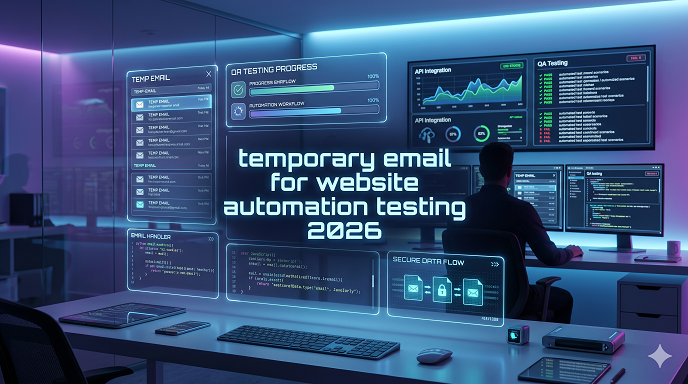
That is when I realized that checking your inbox manually is not just slow; it is a massive risk. In this guide, I am going to walk you through everything you need to know about setting up a temporary email for website automation testing 2026 style.
Whether you are trying to catch OTPs, verify password resets, or ensure your automated lead magnets are actually delivering, relying on your personal Gmail account is not going to cut it anymore. Let us dive into how the professionals handle email sandbox testing today.
Why QA Email Testing is Harder Today
What most people do not realize is that testing email flows is vastly different now than it was even a couple of years ago.
We are dealing with aggressive spam filters, dynamic IP blocking, and complex authentication protocols like DMARC and BIMI. If your app sends out a hundred test emails to the same domain during a QA sprint, your server reputation might tank before you even launch.
Furthermore, user verification has gotten more complex. We are not just looking for a simple "Welcome" message anymore. We need to extract six-digit OTP codes, click magic login links, and verify that dynamic affiliate tags are correctly embedded in the email body.
To do this at scale, you need automation. And to automate, you need a reliable temporary email setup that can talk directly to your testing frameworks like Cypress, Selenium, or Playwright.
What is a Temporary Email for Website Automation Testing 2026?
A temporary email for website automation testing 2026 is not your average fake email generator.
Historically, developers would just go to a free site, generate a random inbox, manually click a button on their website, and refresh the browser tab to see if the message arrived. That is fine if you are testing one thing once.
But what happens when you need to run an automated regression suite with 500 tests every time you push code?
Today, a temporary email for testing is an API-first service. It allows your automated scripts to programmatically create fresh, unique email addresses on the fly, wait for incoming messages, extract specific content like verification links or lead gen downloads, and then permanently delete the inbox.
The Core Components of Modern Automation Testing Email Tools
In my experience, a robust email sandbox testing environment needs a few crucial components to actually be useful. Here is what you should be looking for when building your stack:
Temp Mail API Integration
You need an endpoint that lets your testing script request a new inbox. The temp mail API should instantly return a unique address that you can inject into your signup forms.
Inbound Routing and Webhooks
Instead of writing scripts that constantly poll an inbox to see if a message has arrived, modern tools use webhooks. When you receive email online to your test address, the service immediately pushes a payload to your testing framework.
Content Parsing
This is the magic part. The best tools do not just hand you the raw HTML of the email. They parse the DOM of the message, allowing you to run assertions on specific text blocks, check if the affiliate tracking pixel fired, or pull out an OTP using regular expressions.
See here………..Best TH12 Farming Base Layouts in Clash of Clans (Ultimate Guide 2025)
Top Mailinator Alternatives 2026
For a long time, Mailinator was the go-to disposable email for testing. It was great for its time, but public inboxes are inherently risky for enterprise or sensitive testing, and free tiers often struggle with modern API demands.
After working with dozens of development teams, I have seen a massive shift toward more specialized platforms. While I will not bore you with a massive list of sales pitches, here are the types of Mailinator alternatives 2026 demands:
- Private Email Sandboxes
- These tools give you a dedicated testing domain. No one else can see your inbound mail, which is crucial if you are testing password resets or sensitive lead generation data.
- Developer-First Email APIs
- Platforms specifically built for Cypress and Playwright. They come with pre-built Node.js or Python SDKs so you do not have to write custom HTTP requests to fetch your test emails.
- Local SMTP Catchers
- For local development, tools that run a dummy SMTP server on your machine are invaluable. They intercept outgoing mail from your local environment and display it in a web interface, preventing you from accidentally spamming real users while coding.
Step-by-Step: Setting Up Your First Automated Email Test Flow
Let us get practical. How do you actually implement this? Here is the exact workflow I use when setting up a testing pipeline for a new client's lead generation funnel.
Step 1: Provision the Inbox via API
Inside your test script (let us say, in Cypress), the first action is an API call to your temp mail provider. You request a new inbox. The provider returns an email address like [email protected].
Step 2: Inject the Email into Your UI
Your automation script navigates to your application's signup or opt-in form. It fills out the name, maybe selects a few dropdowns, and inputs that newly generated test email address. It then clicks submit.
Step 3: Await the Inbound Message
This is where old scripts used to fail. Instead of a hard sleep timer (which is incredibly flaky), you use the temp mail API to wait for an inbound message matching a specific subject line, like "Confirm Your Subscription."
Step 4: Extract and Assert
Once the email is caught, the API returns the email body. Your script parses this body. You extract the confirmation link.
Step 5: Complete the Loop
Your script navigates to the extracted confirmation link, verifying that the application successfully activates the account or delivers the promised affiliate resource. Finally, you assert that the success page loaded.
Pros and Cons of Using Disposable Email for Testing
Before you completely overhaul your QA process, it is important to understand the trade-offs. Nothing in software engineering is a silver bullet.
The Advantages
- Complete Automation: You remove human error from the equation. Tests run at 3 AM without anyone needing to check an inbox.
- Scalability: Need to simulate 1,000 users signing up simultaneously? A temp mail API can handle that instantly.
- Privacy and Security: Dedicated sandboxes ensure that test data, API keys, or proprietary links do not leak into public disposable inboxes.
The Disadvantages
- Integration Time: Setting up webhook listeners and parsing logic takes an initial time investment.
- Cost: While public fake email generators are free, reliable API-driven sandboxes usually come with a monthly subscription fee.
- Deliverability Quirks: Some strict security firewalls might block incoming test domains, meaning you have to whitelist your testing tools internally.
See here……..How to learn English fast for beginners
5 Common Mistakes in QA Email Testing (And How I Fix Them)
Over the years, I have made almost every mistake possible when building out QA email testing pipelines. Here are the pitfalls you should avoid:
Mistake 1: Using Hardcoded Email Addresses
If you use [email protected] for every automated run, your tests will fail the second time they run because the database will say "User already exists." Always generate a unique alias or a completely new temporary inbox for every single test run.
Mistake 2: Relying on Static Sleep Timers
Emails do not arrive instantly. Network latency happens. If your script waits exactly 5 seconds and then fails, you will get flaky tests. Always use dynamic polling or webhooks that wait up to a sensible timeout (like 30 seconds) before failing.
Mistake 3: Ignoring Spam and Bounce Rules
Just because an email arrived in your testing sandbox does not mean it will reach a real user. Your testing tool should ideally evaluate the spam score of the incoming message and alert you if your SPF or DKIM records are broken.
Mistake 4: Not Testing the Unsubscribe Flow
Everyone tests the signup. Almost nobody tests the unsubscribe. In 2026, privacy regulations are stricter than ever. Your automation suite must verify that clicking "Unsubscribe" actually updates the user's database record.
Mistake 5: Using Public Inboxes for Private Data
I once saw a company testing their invoice generation system using a public temporary email. Anyone could type in that address and see highly sensitive staging data. Always use private testing domains.
Real-World Case Study: Fixing a Leaky Affiliate Funnel
Let me share a quick story that highlights why this matters. I was consulting for a brand that relied heavily on affiliate marketing. Their affiliates drove traffic to a lead magnet, and the system was supposed to send a PDF download link while tagging the user in the CRM with the affiliate's ID.
Affiliates were complaining that they were not getting credited for leads.
We set up an automated testing suite using a temp mail API. The script simulated a user clicking an affiliate link, signing up with a fresh temporary email, and waiting for the PDF.
Our automated testing revealed the issue immediately. The email was arriving, but the dynamic affiliate tracking parameter embedded in the email link was being truncated by a recent update to the email templating engine. The user got the PDF, but the affiliate lost the commission.
By having a robust automation testing email tool, we caught the truncation, pushed a fix, and added a permanent regression test to ensure that exact parameter was always present in future builds. It saved the client's relationship with their partners.
FAQs: Quick Answers to Your Testing Dilemmas
Question: Can I just use Gmail aliases (like [email protected]) instead of a temporary service?
Answer: You can, but it is risky for scale. Google will eventually rate-limit you or flag your IP if you are sending hundreds of automated emails to the same root inbox in a short period. Plus, automating the reading of Gmail requires dealing with OAuth, which is notoriously frustrating for headless browser testing.
Question: Are fake email generators bad for SEO?
Answer: Using them for your own testing does not impact your SEO. However, if your actual application allows users to sign up with known disposable domains, you might end up with a bloated database of fake users, which can skew your engagement metrics and indirectly hurt your marketing efforts.
Question: What is the best way to extract an OTP from an email?
Answer: Use regular expressions (Regex). Most temp mail APIs return the text body of the email. You can write a simple Regex pattern like /\b\d{6}\b/ to instantly grab a six-digit code from the string and pass it back to your UI testing framework.
Question: Do these tools work with continuous integration (CI) pipelines like GitHub Actions?
Answer: Absolutely. Because they are driven by REST APIs, you can trigger these tests from any environment. Just make sure to store your API keys securely in your CI environment variables.
Question: How do I test emails that include attachments?
Answer: Look for an email sandbox testing tool that specifically supports attachment parsing. The API should return a URL or a Base64 encoded string of the attachment, allowing your script to download and verify the file's size or extension.
Final Thoughts and Actionable Takeaways
Testing your email infrastructure should never be an afterthought. The moment a user clicks "Submit," your application's reputation is on the line.
Moving away from manual inbox checking and adopting a dedicated temporary email for website automation testing 2026 strategy is one of the highest-ROI technical decisions you can make. It speeds up your release cycles, catches embarrassing bugs before they reach production, and ensures your critical business funnels—like lead generation and affiliate tracking—actually work.
Start small. Pick one critical flow, like your password reset functionality. Integrate a temp mail API into your existing QA framework, write a single automated test, and watch it run. Once you see the magic of a headless browser receiving an email, parsing a link, and verifying the page entirely on its own, you will never want to go back to manual testing again.
Protect your application's user experience by treating email testing with the exact same rigor you apply to your database or frontend code. It is an investment that pays off every single time you deploy.